





Why Does a DC Cooling Fan Fail to Start? Startup Voltage and Current Explained
A DC cooling fan may fail to start even when connected to a power supply with the correct rated voltage. Sometimes the blades move briefly and stop. In other cases, the fan runs normally on a laboratory power supply but repeatedly fails when installed in the finished equipment.
These symptoms do not necessarily indicate a defective motor. A voltage drop during startup, insufficient power supply capacity, an unsuitable speed-control command, or mechanical resistance can all prevent a brushless DC fan from reaching its operating speed.
Start by checking the voltage directly at the fan terminals while startup is attempted. A supply that measures 12V without a load may not maintain that voltage when the fan begins drawing current.
The following troubleshooting process explains how starting voltage, transient current, wiring, and fan control interact, and what OEM engineers should verify before approving a DC cooling fan for production.
Why Does a DC Cooling Fan Fail to Start With the Correct Voltage?
The voltage shown on a power supply label is not always the voltage available at the fan during startup.
A brushless DC cooling fan contains electronic drive circuitry that must energize the motor and accelerate the rotor from rest. The electrical demand during this process differs from steady operation.
If the supply enters current limiting or the voltage at the fan terminals falls below the fan's required startup conditions, the driver may fail to complete startup. Depending on the design, the fan may remain stationary, briefly twitch, or repeatedly attempt to restart.
The same visible symptom can also result from an incorrect control command or mechanical obstruction.
| What happens | What it may indicate | First check |
|---|---|---|
| Fan twitches and stops | Supply voltage drop, control issue, or mechanical resistance | Measure terminal voltage during startup |
| Fan works on a bench supply but not in the equipment | Different supply capacity, wiring, or control conditions | Compare the two electrical setups |
| Fan starts only after several attempts | Marginal startup conditions or intermittent connection | Capture repeated startup attempts |
| Fan runs at full speed but will not start at low speed | Starting command or applied voltage is too low | Verify the specified startup method |
| Fan does not move at all | No power, incorrect wiring, disabled control, or fan fault | Check supply, polarity, and connections |
These observations help narrow the fault, but no single symptom proves that a particular component has failed.
What Is the Difference Between DC Fan Starting Voltage and Rated Voltage?
Rated voltage identifies the nominal supply for a particular fan configuration. Starting voltage refers to the voltage required to initiate rotation under specified conditions.
A fan can sometimes continue rotating at a voltage lower than the one needed to start it from rest.
This distinction matters when equipment reduces fan speed by lowering its supply voltage. A voltage that keeps an already rotating fan running may not provide reliable startup after the system has been switched off.
Analog Devices explains that the starting-voltage requirement can vary between fan designs and individual units. Therefore, no single reduced-voltage threshold should be applied to every 5V, 12V, or 24V DC fan.
Why Does a Fan Run at Low Voltage but Refuse to Start There?
Consider a compact electronic device that operates its cooling fan at reduced speed during standby.
If the controller immediately applies a low supply voltage while the rotor is stationary, the fan may not start, even though it would continue rotating at that voltage after reaching speed.
Where supported by the fan and control design, an appropriate startup command can be applied before reducing the operating speed.
However, the required voltage and timing must be verified for the selected fan. Increasing the supply above the rated operating range is not an acceptable general solution.
The distinction is also important for fans with a dedicated PWM input. Reducing the DC power supply is not necessarily equivalent to commanding a lower speed through the specified control interface.
If the manufacturer does not publish the required startup conditions, engineers should obtain the relevant data or validate representative samples rather than assume that the normal running-voltage range also guarantees startup.
How Can Startup Current Cause a DC Cooling Fan Voltage Drop?
A fan's electrical current is not constant throughout startup.
When power is first applied, the internal electronics may produce a brief inrush current. The motor then draws current while accelerating, before settling into its normal operating condition.
These events are related but should not be treated as identical.
| Current condition | What happens | Why it matters |
|---|---|---|
| Power-on inrush | Drive electronics and internal capacitors are energized | May affect supply protection or create a brief current peak |
| Motor startup | The rotor accelerates toward operating speed | May cause voltage sag if the supply cannot support the transient load |
| Steady running | The motor maintains its operating speed | Used for normal power and thermal budgeting |
| Locked rotor | Rotation is obstructed or unable to develop | May trigger current limiting or protective restart behavior |
The magnitude and duration of these currents depend on the fan model, drive circuitry, voltage, and operating conditions. It is not reliable to estimate every fan's startup-current peak using a fixed multiple of its rated current.
Why Rated Current Alone Is Not Enough
A published rated current can help engineers size the continuous power budget, but it cannot establish the complete startup load.
For example, YCCFAN's DC5020 50×50×20mm DC cooling fan includes a 12V configuration, YDH5020X12, with a listed rated current of 0.14 A.
This gives an approximate nominal running input of:
12V × 0.14A = 1.68 W
That figure is useful for continuous-power planning in a compact electronics assembly. It does not tell the engineer the peak current during power-on or motor acceleration.
If the fan fails to start from a small DC-DC converter, the next step is not to assume that a 0.14 A supply rating must be sufficient. The converter's transient capability, actual startup-current waveform, and voltage at the fan terminals need to be checked.
This principle applies to other DC cooling fan sizes as well.
How Wiring and Power Supply Limits Contribute
Consider a 12V fan powered through a converter and a relatively long cable.
The supply may maintain 12V under steady conditions, but startup current flowing through cable resistance, connectors, protection components, and PCB traces can create an additional voltage drop.
In simplified form:
Voltage drop = current × total series resistance
If the converter also reaches its current limit, the voltage available to the fan may fall further.
In some systems, the fan driver stops, the supply voltage recovers, and another startup attempt begins. This can produce repeated twitching or intermittent rotation.
The important measurement is the voltage at the fan connector during the event, not merely the voltage displayed at the power supply.
How Do You Troubleshoot a 12V DC Fan That Spins Briefly and Stops?
A useful diagnostic process separates power delivery, control behavior, and mechanical condition. Changing the fan immediately can hide the original problem if the replacement is tested under different conditions.
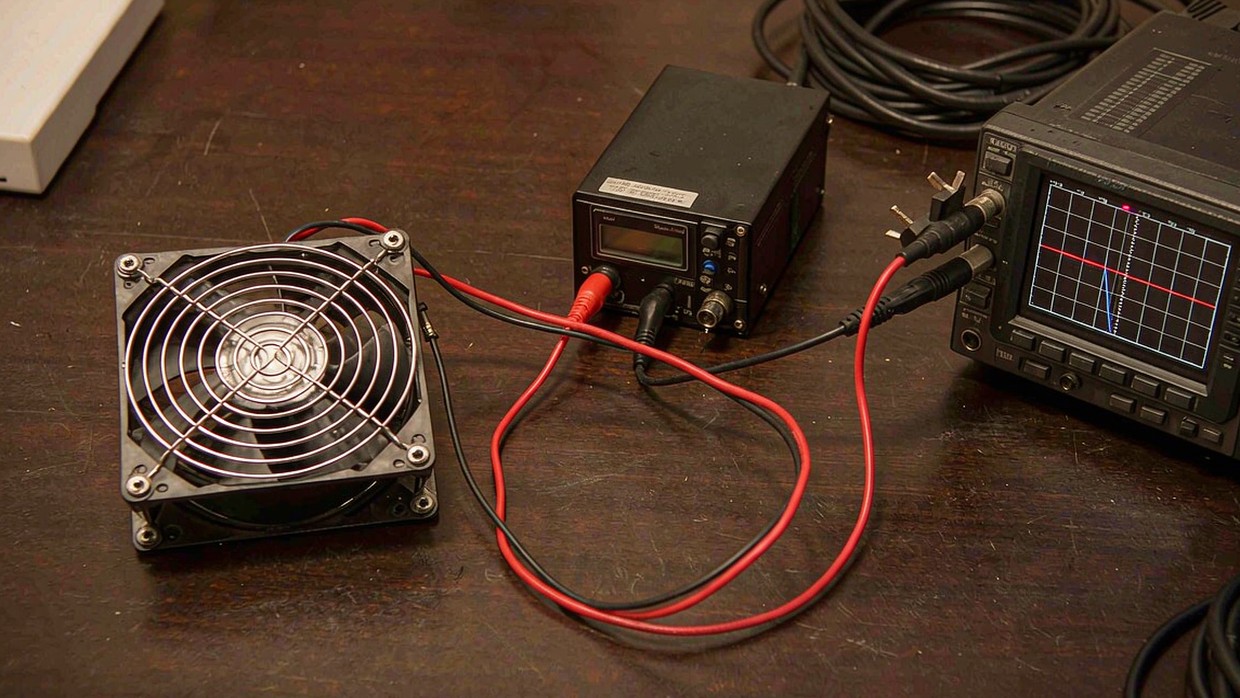
Bench measurement of fan-terminal voltage and current during a startup attempt
1. Capture the Voltage Drop During Startup
Confirm the fan's rated-voltage configuration and correct wiring, then measure the voltage across its power terminals while startup is commanded.
If the voltage drops sharply, investigate the converter's current limit, source impedance, wiring, connectors, and any loads starting at the same time.
Short transients may be difficult to capture with a standard multimeter. A suitably configured oscilloscope can show the supply voltage and current throughout the startup attempt.
Recording both signals is especially useful when the fan repeatedly starts and stops.
2. Compare the Bench Supply With the Installed Power Source
When a fan starts reliably on a laboratory supply but fails in the final equipment, compare the conditions rather than assume that the fan is defective.
The bench setup may have shorter leads, greater transient current capability, or a different startup command.
A direct comparison should examine the fan-terminal voltage, current waveform, connector, active system loads, and control state.
If the voltage is stable in both setups, the next investigation should focus on the control interface and mechanical installation.
3. Check Control and Mechanical Conditions
A dedicated PWM input must receive a valid startup command according to the selected fan's interface requirements.
If the equipment controls fan speed by varying supply voltage, the applied startup voltage must be sufficient for that fan. The appropriate method depends on the drive electronics and should not be assumed from wiring color or fan size alone.
If supply and control conditions are correct, inspect the fan for obstructions, mounting distortion, cable interference, or abnormal bearing resistance.
Temperature may also influence startup behavior, especially where mechanical friction or lubricant characteristics change under cold conditions.
Inspect the impeller only when the equipment is safely de-energized. Do not attempt to assist a powered fan by touching its blades.
A fan that passes an open-bench test should still be checked in its final mounting arrangement.
Can PWM or Fan Feedback Help Identify Startup Problems?
Power delivery is not the only reason a fan may fail to rotate.
With a compatible four-wire or other dedicated-control configuration, the supply voltage can remain normal while the controller sends an unsuitable startup command.
This can produce a stationary fan without the voltage collapse that characterizes some power-supply failures.
Engineers should therefore check the supply voltage and control signal during the same start attempt.
Where the exact fan configuration supports them, FG and RD signals can provide additional information about rotation or a defined fault condition.
However, the absence of FG pulses immediately after power-on does not automatically indicate failure. The controller needs to account for the specified startup interval and the interface's expected signal behavior.
Similarly, an automatic-restart function does not eliminate the need for a suitable power source and a valid startup command.
For diagnosis, the objective is to establish whether the fan received adequate power and an appropriate command, and whether rotation followed as expected.
How Should OEMs Validate DC Fan Startup Before Mass Production?
A fan that starts successfully once at room temperature may still fail under the conditions encountered in finished equipment.
OEM validation should use the intended supply, wiring, connector, controller, and installation arrangement.
The test plan should cover the relevant operating limits rather than rely only on nominal voltage and steady-state current.
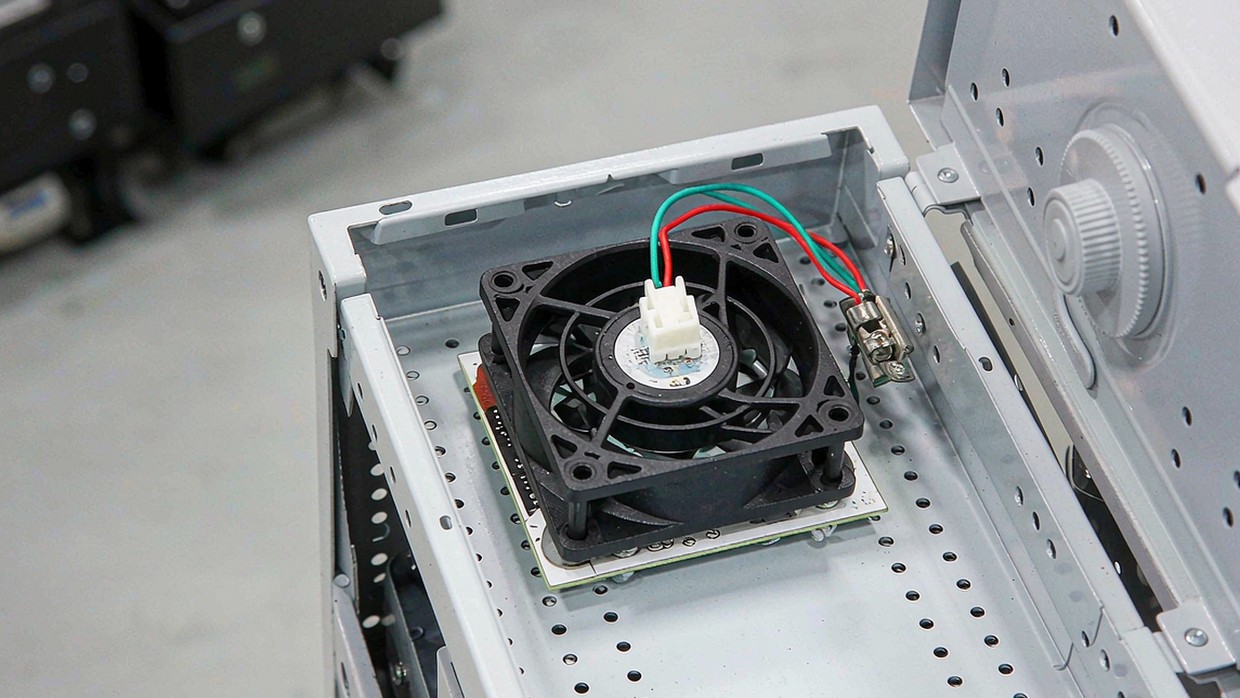
A cooling fan validated in its final mounting arrangement inside the equipment
| Test condition | What to verify |
|---|---|
| Minimum allowed supply voltage | Reliable startup under the specified low-voltage condition |
| Startup current | Peak value, duration, and supply response |
| Repeated power cycling | Consistent acceleration without unexpected resets |
| Cold and hot startup | Behavior across the required temperature range |
| Production wiring | Voltage drop through actual cables, connectors, and PCB traces |
| Control and feedback | Startup command and valid FG/RD behavior, where configured |
| Shared power supply | Startup with other equipment loads or fans active |
| Final installation | Clearance, mounting condition, and reliable operation |
Engineers should define acceptable startup time, terminal-voltage limits, and pass/fail criteria from the selected fan's requirements and the equipment's intended operating conditions.
What If Several Fans Start at the Same Time?
Multiple fans connected to one supply may create a combined transient demand that is significantly different from the load observed when each fan is tested separately.
If the supply cannot support the simultaneous demand, one or more fans may fail to start or the converter may enter protection.
Where appropriate, staggered startup may reduce the peak load. However, the sequence must remain compatible with the equipment's thermal and control requirements.
For continuous-duty equipment, restarting after a brief power interruption is another important verification condition.
The final approval should be based on the behavior of the complete assembled system, not a single isolated fan.
Frequently Asked Questions About DC Cooling Fan Startup
Why does a 12V DC fan twitch but not start?
A brief movement followed by a stop may result from voltage sag, power-supply current limiting, an unsuitable startup command, or mechanical resistance. Measure the fan-terminal voltage during startup and compare it with the selected fan's requirements.
Can a DC fan operate below its starting voltage?
Some fans can continue rotating at a lower voltage than they need to start from rest. This depends on the particular motor and drive design, so the applicable startup requirement must be confirmed.
Is fan startup current higher than rated current?
It can be, but the peak and duration vary by fan design. Power-on inrush, motor acceleration current, and steady running current should be evaluated separately rather than estimated using a universal multiplier.
Why does a fan work on a bench supply but not in the equipment?
The installed supply may have different transient capability, longer wiring, additional loads, or different control conditions. Compare voltage and current at the fan terminals during startup in both arrangements.
Conclusion
A DC cooling fan that fails to start is not necessarily defective. The cause may be an inadequate supply during startup, excessive wiring voltage drop, an unsuitable control command, or a mechanical problem.
The most effective diagnosis is to measure the actual startup event, identify which condition differs from the fan's requirements, and verify the corrective action in the finished equipment.
For OEM applications, the relevant fan model, startup conditions, supply behavior, and production wiring should be confirmed together. This provides a stronger basis for reliable operation than selecting a fan from rated voltage and current alone.
Technical References
The following references are original technical materials from Analog Devices. The YCCFAN rated-current example is sourced separately from the linked official DC5020 product specifications.
Analog Devices — Why and How to Control Fan Speed for Cooling Electronic Equipment
Fan-control methods, starting-voltage considerations, and two-, three-, and four-wire interface principles.
https://www.analog.com/en/resources/analog-dialogue/articles/how-to-control-fan-speed.html
Analog Devices — Rev Up Your Fan-Speed Control Designs
Variation in brushless DC fan starting voltage and suitable startup-control approaches.
https://www.analog.com/en/resources/technical-articles/rev-up-your-fanspeed-control-designs.html
Analog Devices / Maxim Integrated — MAX6620 Quad Linear Fan-Speed Controller Datasheet
An example of a fan-control IC that supports controlled startup and speed monitoring. Its specifications apply to MAX6620-based designs and do not establish the startup behavior of all DC fans.
https://www.analog.com/media/en/technical-documentation/data-sheets/MAX6620.pdf