



Industrial Cooling Fans: How they work, Uses and Benefits
Heat is a hard cap on productivity in plants, data halls, and process lines. Industrial Cooling Fans remove that cap by using forced convection to pull heat off components and out of enclosures, keeping temperatures—and performance—under control. In the guide below, you’ll see how industrial cooling fans work, which types fit different constraints, the specs that actually matter (airflow, static pressure, noise, efficiency, ratings), where they’re used across industries, and the measurable benefits they deliver.
How Industrial Cooling Fans Work ?
Forced convection (the simple physics)
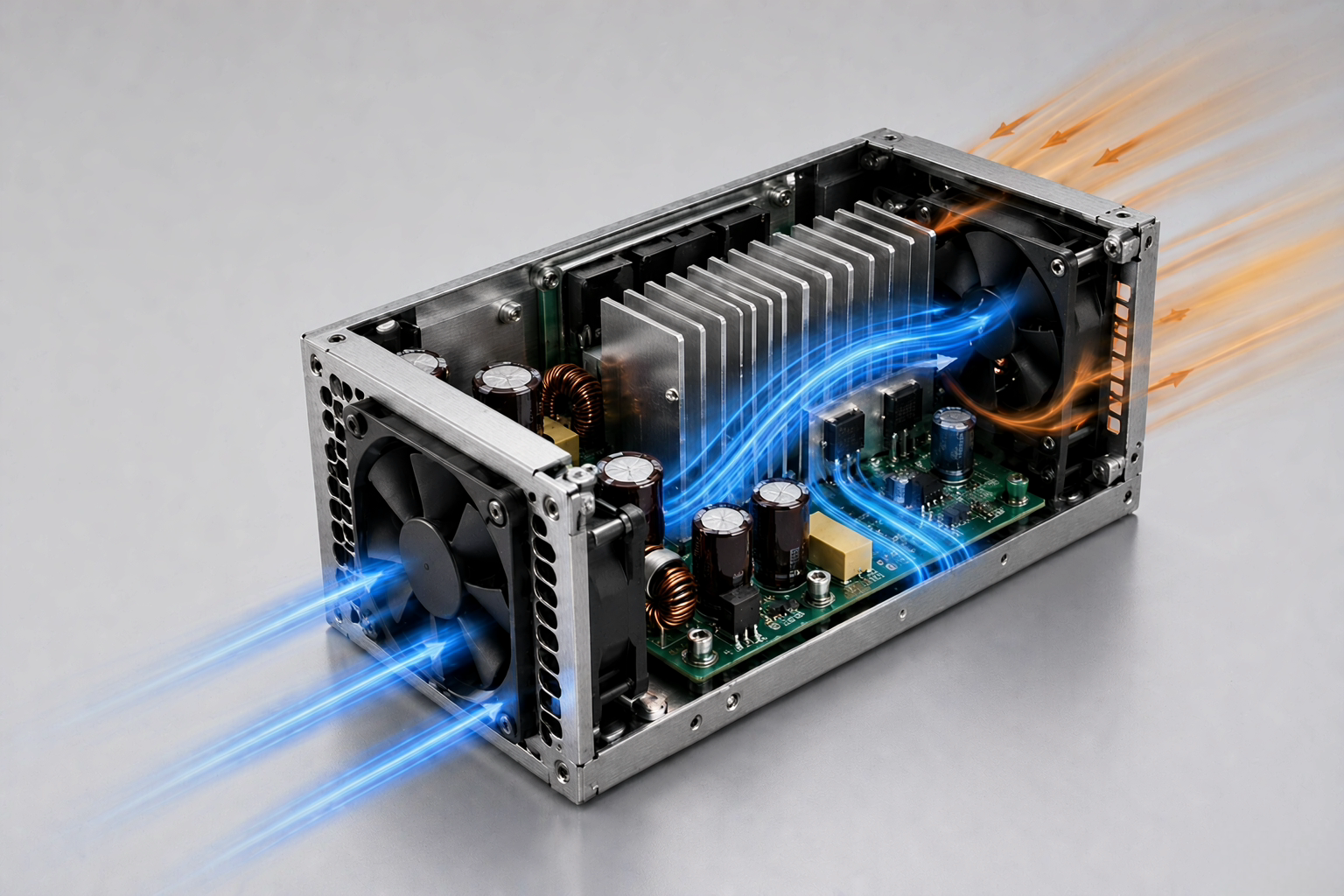
An industrial cooling fan drives faster air across hot parts or through a heat exchanger, so more heat is removed per unit time. Higher velocity raises the Reynolds number, thins the boundary layer, and increases the effective heat-transfer coefficient—summarized by h·A·ΔT. Smart ducting (shrouds, plenums, baffles) concentrates flow on genuine hotspots and cuts bypass losses, while tight sealing prevents short-circuit recirculation where warm exhaust drifts back to the inlet.

Fan types and when they shine
Axial fans (propeller style)
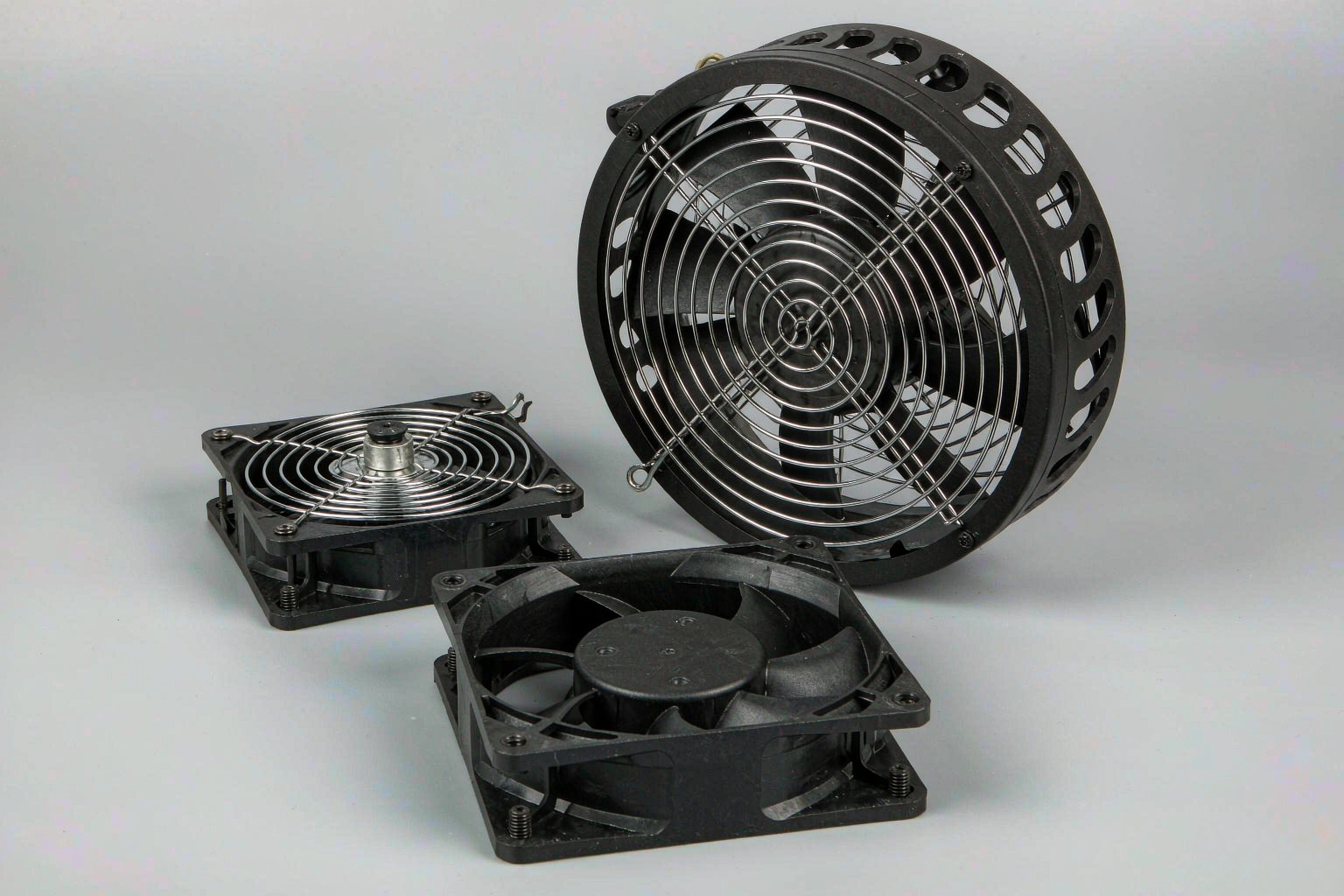
Axials move air straight through—intake and discharge on the same axis—so they deliver large volume when system resistance is low. They’re a go-to for enclosure ventilation and big open spaces. Larger diameters and well-shaped blades achieve the same CFM at lower tip speed (and usually lower noise). Because static pressure is limited, they work best with short, smooth paths and minimal obstructions. Panel mounts and “fan-wall” arrays are common in cabinets and warehouse make-up air.
Centrifugal fans / blowers
Centrifugals take air in axially and throw it out radially, exchanging some flow capacity for higher static pressure. That pressure keeps air moving through dense fins, coils, filters, long ducts, or outdoor runs. Impeller options—forward-curved, backward-inclined, radial—balance efficiency, acoustics, and debris tolerance differently. Their steadier pressure head sustains flow as filters load or duct friction rises, making them a strong choice for coil packs, fume capture, and equipment vented to the outdoors.

Cross-flow (tangential) fans
Cross-flow units produce a long, even curtain of air along the fan’s length, ideal when uniform coverage beats peak pressure. They’re well suited to sweeping a coil face, cooling wide electronics panels, or forming an air curtain. Compact and quiet, they prefer low-loss paths because static-pressure capability is modest. You’ll often find them in fan-coil units, display cases, consoles, and other wide-format enclosures where even distribution is the priority.
The specs that matter
Airflow (CFM | m³/h)
How much air an industrial cooling fan actually moves. More CFM usually improves heat removal in open paths or large volumes, but only if the downstream path isn’t choking flow. Size to a target face velocity and duty cycle; remember that adding industrial cooling fans in parallel brings diminishing returns once the system curve steepens.
Static pressure (inH₂O | mmH₂O | Pa)
The fan’s “muscle” against restrictions—dense fins, dusty filters, tight ducts, long runs. Match the industrial cooling fan curve to your system curve at the real operating point, and leave pressure head for future additions (extra filter, coil) so airflow doesn’t collapse later.

Efficiency & power
Wire-to-air efficiency depends on motor, impeller, and operating point. EC-motor industrial cooling fans and well-tuned VFDs cut watts while enabling precise speed control. Aim to run near the best-efficiency point (BEP); overspeeding past it wastes energy and often adds heat and noise back into the space.
RPM & noise (dBA)
Tip speed drives both capacity and loudness. A larger-diameter industrial cooling fan can deliver the same flow at lower RPM—typically with less noise. Don’t judge by a single dBA figure: tonal peaks and blade-pass frequencies matter for comfort and compliance in occupied areas.
Environment ratings
Verify temperature limits, IP (or NEMA) ingress protection, wash-down/sanitary needs, and corrosion resistance for coastal or chemical atmospheres. For hazardous zones, specify the correct ATEX/IECEx class. Bearings, insulation class, and lubricant should suit how and where the industrial cooling fan will run.
Controls and integration
Speed control (VFD / PWM / EC)
Variable speed lets the industrial cooling fan follow real thermal load, trimming energy and sound at part load. Define a usable turndown range, set a minimum to avoid stall, and favor closed-loop control (temperature or differential pressure) over fixed schedules.

Sensors & monitoring
Instrument temperature, differential pressure (across filters/coils), and vibration for alarms and trend analysis. Small upticks in ΔP or vibration usually flag clogging or bearing wear long before airflow drops—cheap protection against downtime in industrial cooling fan systems.
Airflow management
Bellmouth inlets, smooth transitions, turning vanes, and tight shrouds cut separation and recirculation. The goal is to align the system curve with the fan’s sweet spot so the same industrial cooling fan delivers more usable CFM per watt.
System view, not just the industrial cooling fan
Think in systems
Cooling performance is the sum of intake, filters, coils, bends, leaks, and exhaust. Keep paths short and smooth, seal gaps, and physically separate intake from discharge to avoid hot-air short-circuiting. Maintain make-up air, change filters by ΔP (not calendar), and re-verify flow after process changes—the whole industrial cooling fan system is what keeps temperatures under control.

Industrial Cooling Fan Uses
Industry / Sector | Typical Applications |
Process & discrete manufacturing | Cooling drives, motors, weld cells, ovens’ exteriors, injection molds, control cabinets; Spot cooling for operators and workstations |
Power & energy | Generator enclosures, transformers, rectifiers, battery rooms, inverter skids for solar/wind |
Food & beverage | Evaporator/condensing units, blast chillers, packaging lines, wash-down enclosures |
Chemical, pharma, and clean industries | Fume-extraction assist, scrubber/aerosol control, HEPA systems, lab equipment, cleanroom make-up/recirculation |
Data centers & electronics | Server racks, in-row coolers, UPS rooms, telecom shelters, test chambers |
Metals, mining & heavy industry | Kiln/forge area ventilation, conveyor drives, MCC rooms, dust-collection assists |
Facilities & infrastructure | HVAC make-up air, warehouses, tunnels, substations, agriculture/greenhouses, marine engine rooms |
Benefits of Cooling Fans
Uptime and reliability
Lower operating temperatures reduce thermal stress, cutting nuisance trips, derating, and early failures. An industrial cooling fan that holds ΔT in check also minimizes thermal cycling—the nemesis of solder joints, elastomers, and sensitive sensors. A commonly cited guideline in electronics: trimming temperature by about 10 °C can markedly extend life, yielding fewer replacements and steadier MTBF.
Product quality & process stability
Tight thermal control lifts yields in molding, food processing, electronics assembly, and reaction-driven processes. Stable temperatures keep viscosity, cure profiles, and kinetics inside spec, which shrinks scrap and rework. Uniform airflow from an industrial cooling fan system helps instruments and vision systems stay calibrated, improving long-run SPC performance.
Energy savings
Right-sized fans with VFD/EC control follow real load instead of running flat out. By the fan affinity laws, a ~20% speed reduction can translate to roughly 50% less power (P ∝ N³), making turndown a high-impact lever. Pair the industrial cooling fan with smooth inlets, low-loss ducting, and adequate pressure head to avoid throttling—more useful CFM per watt, especially at part load.

Safety & compliance
Good ventilation reduces worker heat stress, manages fumes and particulates, and supports regulatory targets for temperature, airflow, and hazard zones. Directed flow from an industrial cooling fan keeps enclosure surfaces within safe limits and prevents hotspots near combustible dusts or vapors. With proper IP/NEMA construction and ATEX/IECEx selection, the fan won’t introduce ignition or contamination risk.
Lifetime cost reduction
Efficiency plus condition-based maintenance (vibration/temperature trending and filter ΔP) lowers downtime and stretches asset life. Servicing bearings, belts, and filters based on data avoids both premature swaps and catastrophic failures. Over the lifecycle, energy, maintenance, and lost production dominate costs—so a high-efficiency industrial cooling fan typically wins on total cost of ownership.
Flexibility & scalability
Modular fan walls and plenum arrays scale capacity, add N+1 redundancy, and allow zoned delivery. Independent VFD control per module supports seasonal turndown, isolating sections for service, and rebalancing after layout changes—without major duct rework. If one module goes offline, the industrial cooling fan array backfills to keep process airflow on spec.

Conclusion
Choosing the right solution isn’t just about a fan—it’s about a complete industrial cooling fan system matched to your ducting, filters, coils, and controls. Align the fan and system curves, manage intake and exhaust to prevent recirculation, instrument ΔP/temperature for condition-based maintenance, and use EC/VFD control to track real load.