





12V Blower Fan Selection Guide: Current, RPM, Noise, and Static Pressure Explained
Choosing a 12V blower fan is more involved than matching the voltage rating. In real installations, airflow is shaped by duct losses, filters, grilles, and heatsinks, so the fan’s free-air rating rarely reflects what you get in the product. This guide explains how to balance four practical factors—current draw, RPM, noise, and static pressure—so you can select a blower fan that meets cooling targets, power limits, and acoustic requirements in electronics, appliances, and vehicle systems.
Introduction: Why 12V Blower Fan Selection Is More Than Voltage
To select a 12V blower fan, first confirm the available installation size and the airflow required at the system’s actual static pressure. Then compare current, RPM, noise, bearing type and control functions such as PWM, FG or RD. A blower should not be selected only by its maximum free-air CFM because filters, heat sinks, grilles and narrow ducts can significantly reduce airflow after installation.
The common mistake: “12V = compatible”
A 12V label only tells you the fan can run on a 12‑volt supply. It does not guarantee the fan will deliver the airflow you need once it is installed. The moment you add ducts, filters, sharp bends, tight vents, or dense heatsinks, your system creates resistance. That resistance shifts the operating point and can cut airflow dramatically—especially if the fan was selected using only free‑air CFM.
Reliable selection comes from balancing four linked pillars: Current (A), RPM (speed), Noise (dBA and perceived sound quality), and Static Pressure (the ability to push air against resistance). Increasing RPM may raise airflow and pressure, but it often increases noise and current draw as well. The goal is not “maximum specs,” but the best operating point for your real system.
A 12V rating confirms the required power architecture, but it does not confirm airflow, pressure, noise or installation compatibility.
Who this guide is for
This guide is for engineers, OEM buyers, automotive retrofit users, and appliance designers. Common use cases include electronics cooling inside enclosures, airflow through ducts or filters, cabinet ventilation, and 12V blower fan for car projects where vibration and electrical transients are part of daily operation.
What Is a 12V Blower Fan?
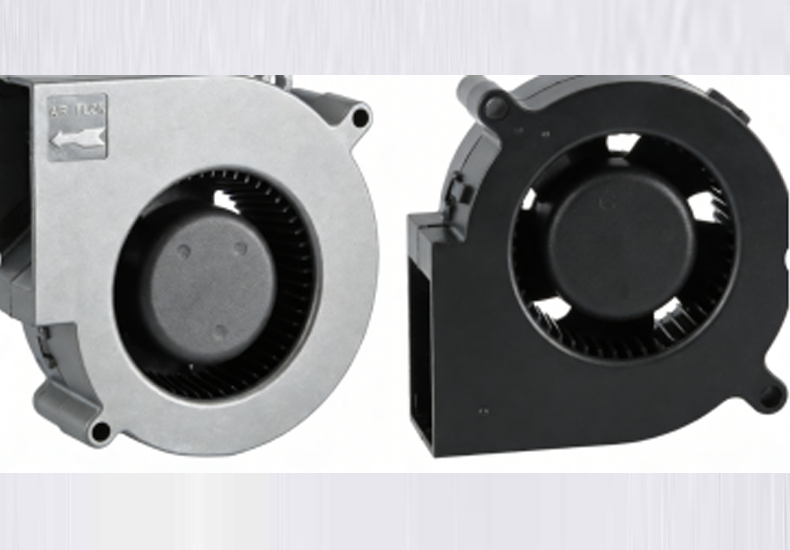
12V blower fan vs 12V axial fan (quick clarification)
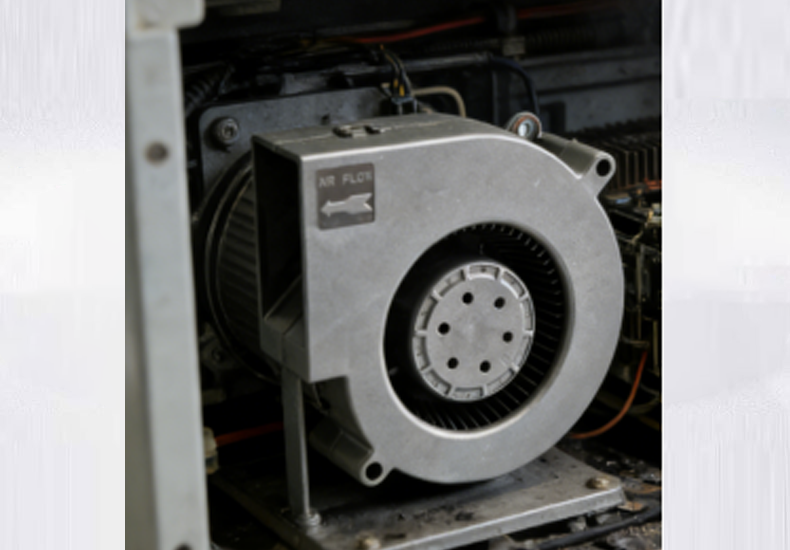
A 12V blower fan is usually a centrifugal design: air enters near the center and exits through a side outlet. This geometry is common in a dc blower because it can build higher static pressure than an axial fan of similar size, which helps when air must move through a restricted path. A 12V axial fan, by contrast, moves air straight through along the motor shaft. Axial fans often excel in open or low‑restriction environments, but their airflow can drop quickly when the system becomes restrictive.
This is why the search term “Small Blower Fan 12V” often signals a pressure problem. If your air path includes a narrow duct, filter, grille, or heat sink, choose based on the pressure curve at your target airflow—not the free‑air airflow number.
Typical categories: dc blower, small blower fan, industrial blower fan
In the market you’ll commonly see:
• DC blower: compact and controllable, widely used in electronics and OEM devices.
• Small blower fan: designed for tight spaces and localized cooling, sometimes using higher RPM.
• Industrial blower fan: built for long duty cycles, tougher environments, and more stable performance under resistance.
Fan Type at a Glance (table):
Type | Common Keyword | Strength | Typical Use |
Centrifugal blower | blower fan / dc blower | Higher static pressure | ducts, filters, hotspots |
Axial fan | 12V DC fan | Higher airflow in open space | ventilation, open enclosures |
Rugged blower | industrial blower fan | Durability + pressure | industrial cabinets, harsh duty |
Is a 12V Blower Fan the Right Voltage for Your System?
A 12V DC blower fan is normally the right choice when the equipment already uses a stable 12V power rail, battery system or DC adapter. Voltage should follow the equipment’s electrical architecture rather than being treated as a direct measure of blower performance.
A 24V blower does not automatically provide more airflow or static pressure than a comparable 12V model. If two blowers use similar housings, impellers, input power and rated speed, their aerodynamic performance may be similar. At the same input power, however, the 24V version draws less current, which can help reduce voltage drop in longer wiring or multi-fan systems.
A standard 12V blower should not be connected directly to a 24V supply. Excess voltage may damage the motor driver, while a 24V blower operated from 12V may fail to start or run below its rated performance. Always confirm the rated voltage and allowable operating range of the selected model.
| Selection Factor | 12V Blower Fan | 24V Blower Fan |
| Typical power system | Compact electronics, 12V adapters and vehicle electronics | Industrial control and 24V equipment |
| Current at the same power | Higher | Lower |
| Long wiring | More sensitive to voltage drop | Easier to manage |
| Airflow and pressure | Depend on blower design | Not automatically higher |
| Main reason to choose | Matches the existing 12V power system | Matches the existing 24V power system |
How to Choose a 12V Blower Fan
Knowing how to choose a 12V blower fan requires evaluating the complete cooling system rather than comparing one maximum specification. Begin with the available installation space and the cooling airflow required at the heat source. Next, consider the resistance created by filters, heat sinks, ducts, grilles and narrow outlets, and use the blower’s P-Q curve to identify whether it can provide the required airflow at that pressure.
After the operating point is confirmed, compare the electrical load, RPM, noise, bearing type and control functions. The selected blower should also be tested in the actual equipment because enclosure design, mounting and airflow restrictions can change the final cooling and acoustic performance.
| Selection Item | What to Confirm | Why It Matters |
| Installation | Size, thickness, inlet, outlet and mounting | Confirms physical compatibility |
| Cooling target | Required airflow and component temperature | Defines the actual cooling demand |
| System resistance | Filters, heat sinks, ducts and grilles | Reduces installed airflow |
| Operating point | Airflow at the required static pressure | More reliable than maximum CFM |
| Electrical load | Voltage, current and power supply capacity | Supports stable startup and operation |
| Noise and control | RPM, noise, PWM, FG and RD | Supports acoustic and monitoring requirements |
| Environment | Temperature, dust, vibration and duty cycle | Affects reliability and bearing selection |
If the required airflow and system resistance are unknown, a 12V blower fan cannot be selected reliably from voltage, RPM or maximum CFM alone.
12V Blower Fan Airflow vs Static Pressure
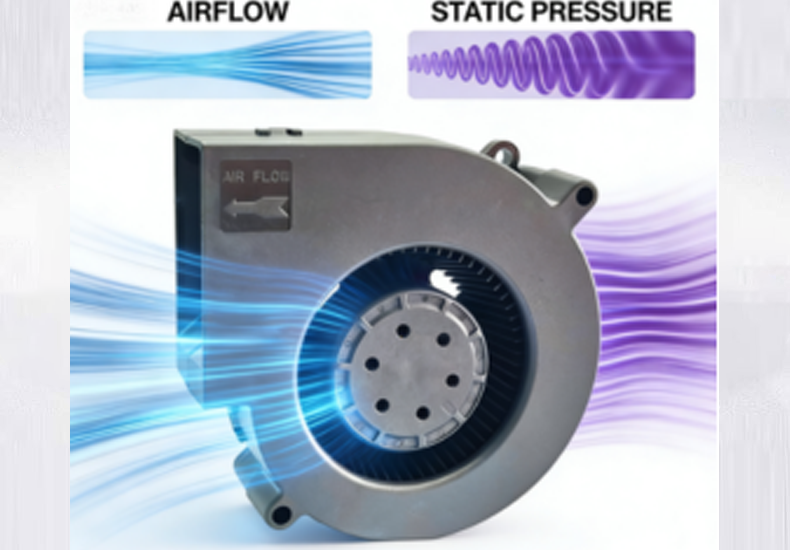
Why static pressure matters more than free-air CFM
Free‑air CFM is measured with minimal restriction. In products, airflow must overcome pressure losses from ducts, bends, filters, grilles, and heatsinks. Static pressure tells you how well a blower fan can maintain airflow when the system resists flow. If your application is even moderately restrictive, static pressure becomes the metric that separates a working cooling design from one that runs hot.
A simple rule of thumb:
• If your system has ducts/filters → prioritize static pressure.
• If your system is open → airflow volume matters more.
This is why blower fans are common in channel cooling and filter/duct setups, while axial fans are common in open ventilation.Maximum airflow and maximum static pressure occur at different points on the blower fan P-Q curve and cannot be achieved at the same time. Maximum airflow is measured with minimal resistance, while maximum pressure occurs when usable airflow approaches zero. The correct model should provide the required airflow at the pressure created by the actual equipment.
Reading performance curves (CFM–Pressure curve)
Use the performance curve to choose correctly. Airflow (CFM) is on the horizontal axis and static pressure is on the vertical axis. As airflow increases, available pressure typically decreases. Your actual operating point is where the fan curve meets your system resistance curve (the pressure drop created by your design at each airflow).
Mini checklist:
• Ducts, filters, or dense heatsinks? Choose for pressure first.
• Open ventilation? Choose for airflow and noise balance.
Current Draw: Why “Amps” Impacts Heat, Reliability, and Power Budget
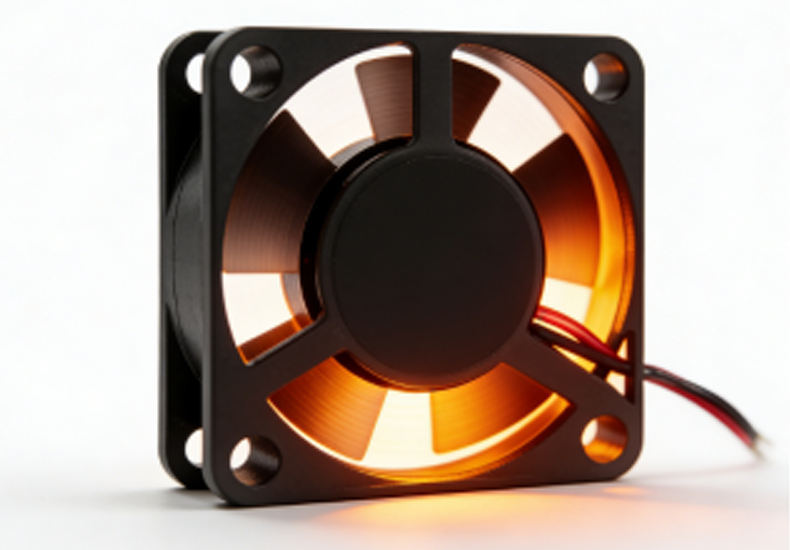
What current tells you about real-world load
Current draw is a practical indicator of how hard the blower is working. Higher current often supports higher torque, higher RPM, or better pressure performance, which can be helpful in restrictive systems. The trade‑off is power consumption and heat. More electrical input means more heat in the motor and driver, which can reduce service life if the fan is operated near limits or in a hot environment.
Power calculation for 12V blower fans
Use the simple relationship:
Power (W) = Voltage (V) × Current (A).
For instance, 12 V × 0.9 A ≈ 10.8 W. This matters for adapter sizing, battery runtime, and thermal design around the motor electronics. In vehicle installations it also affects fuse selection and wiring gauge.
Practical guidance by use case
For electronics, confirm power supply headroom for both steady state and startup. For automotive projects, consider transient voltage, wiring losses, and fusing. If your system runs continuously, verify that the fan’s temperature rise stays within limits at your operating point.
Current Selection by Scenario (table):
Scenario | Typical Concern | What to prioritize |
Small device cooling | heat + noise | efficiency, lower current |
Duct/filtered airflow | airflow stability | higher pressure design |
12V Blower Fan for Car | voltage spikes + wiring | robust driver + protection |
12V Blower Fan RPM and Speed Control
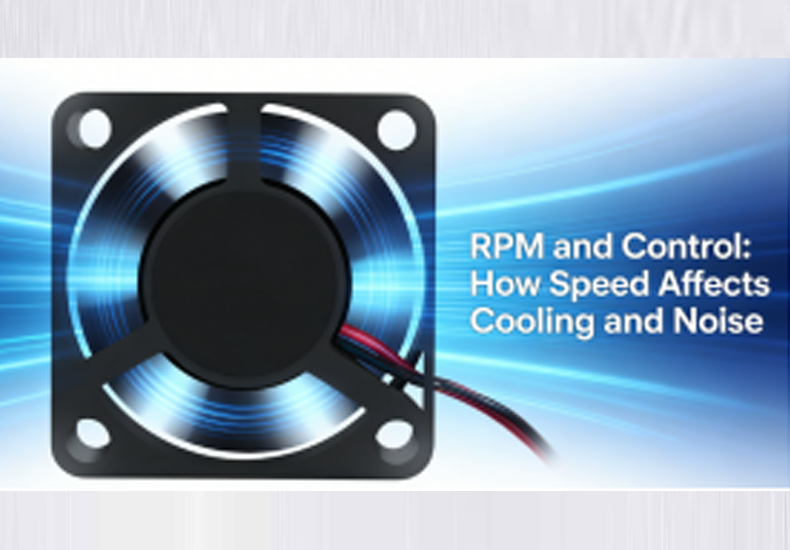
RPM basics: what it changes
RPM drives both airflow and pressure. Higher RPM often improves cooling, but it can raise noise and increase bearing and motor wear—especially if the fan is held at full speed continuously. In a small blower fan, higher RPM is commonly used to compensate for limited diameter, which is one reason compact blowers can be louder than expected.
Speed control options
Common control options include:
• PWM control (preferred for wide control range and stable torque)
• Voltage control (simple, but torque can drop at low voltage)
• Tach/FG signal (speed feedback for monitoring and control)
With PWM, many designs can run quieter most of the time and ramp up only when temperatures rise.
How do I choose the right 12v DC fan?
How do I choose the right 12V DC fan? Begin with the cooling requirement and the airflow path. If restriction is present, select a blower fan (dc blower) that can deliver the needed airflow at the required static pressure. Then confirm that the RPM needed to reach that operating point still meets your noise limit and power budget. Use curves to compare models rather than picking by RPM alone.
PWM, FG and RD Functions for 12V Blower Fans
Control and feedback functions allow a 12V blower fan to respond to changing thermal loads and communicate its operating condition to the equipment controller. PWM adjusts blower speed, FG provides speed feedback, and RD reports a rotor-lock or operating fault. These functions are different and should be selected according to the equipment’s control and monitoring requirements.
| Function | Main Purpose | Typical Requirement |
| PWM | Adjust blower speed | Variable cooling and lower-noise operation |
| FG | Provide speed feedback | RPM monitoring and closed-loop control |
| RD | Report rotor lock or abnormal operation | Fault alarms in critical equipment |
| Auto Restart | Restart after temporary blockage | Systems exposed to occasional obstruction |
| Polarity Protection | Reduce reverse-connection damage | OEM assembly and maintenance |
A PWM blower fan can operate at a lower speed during light thermal load and increase speed as equipment temperature rises. The required PWM frequency, duty-cycle range and wiring definition should be confirmed for the selected model rather than assumed to be identical across all blowers.
How to Compare 12V Blower Fan Noise
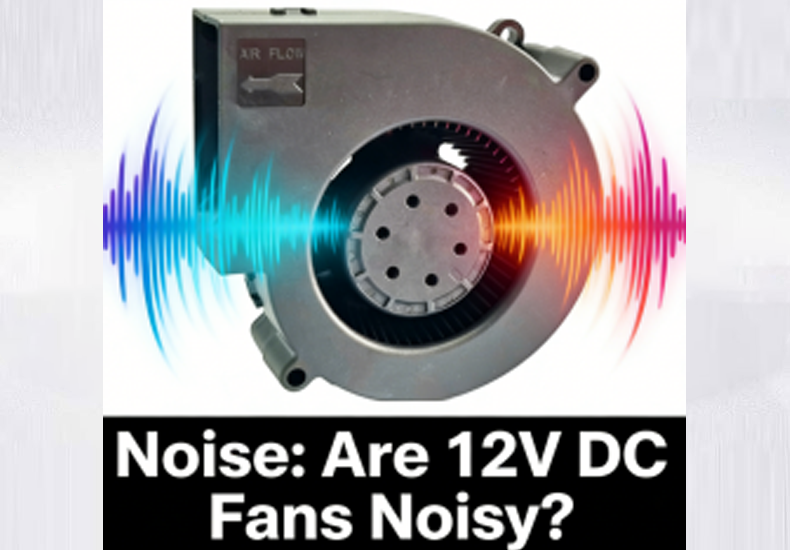
Are 12V DC fans noisy?
Are 12V DC fans noisy? They can be, but noise depends more on design and installation than on voltage. Key drivers include RPM, blade shape, motor commutation, turbulence at the inlet/outlet, and how vibration couples into the enclosure. Axial fans often produce more tonal blade noise, while blower fans can produce broadband noise if the outlet flow becomes turbulent.
Instead of relying on a single dBA number, compare noise at the operating point you actually need. A fan that is quiet in free air may become louder when forced into high restriction and high RPM.A 12V blower is not noisy simply because it operates from a 12V supply. 12V blower fan noise depends on RPM, impeller design, bearing condition, airflow restriction, mounting and enclosure resonance.
How to reduce noise without sacrificing cooling
Practical noise reduction steps:
• Use PWM profiles to avoid running at maximum RPM continuously.
• Smooth the airflow path—avoid sharp edges, sudden contractions, and blocked outlets.
• Use isolation mounts or gaskets to reduce vibration transfer.
• Prevent recirculation so the fan does not chase rising temperatures with higher speed.
Noise testing and why it matters (lab context)
Noise data is most trustworthy when measured in controlled environments such as dedicated noise rooms or anechoic setups. Consistent test conditions—mounting method, distance, background noise, and operating point—are essential for fair comparison between models. If your project is sensitive to acoustics, request test conditions along with the measured values.
12V Blower Fan Applications in Automotive Electronics
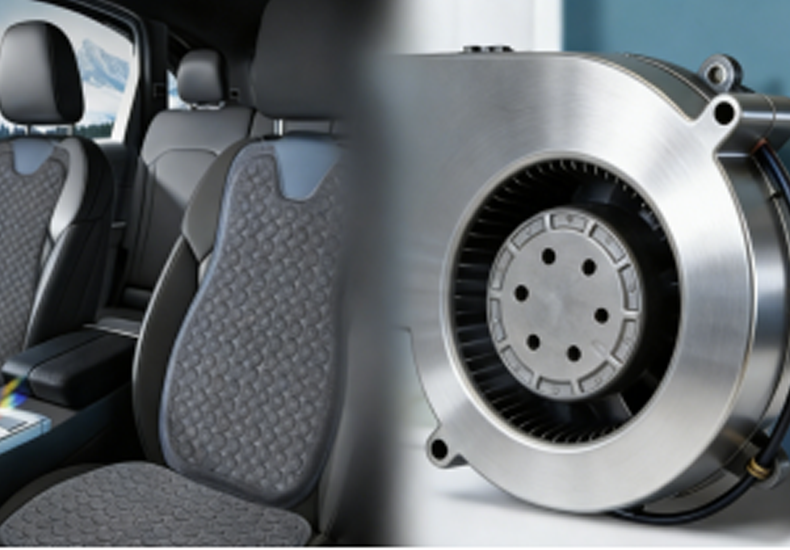
12V Blower Fan for Car: what’s different
A 12V blower fan for car applications must handle a harsher electrical and mechanical environment than typical indoor electronics. Alternator output varies, voltage spikes can occur, and temperatures can swing widely. Dust, vibration, and long duty cycles are also common. These factors make protective features and robust mounting important from day one.
Key automotive selection factors
Focus on protections such as reverse polarity, locked-rotor protection, and auto restart. Confirm connector style and mounting constraints early. If the blower is used near occupants, treat cabin noise as a primary requirement. Smoother airflow paths, vibration isolation, and smart speed control often matter as much as the fan model itself.
Other 12V Blower Fan Applications
In addition to automotive electronics, 12V DC blower fans are used in compact equipment where airflow must be directed through a specific outlet or pushed through moderate system resistance. The most suitable model depends on the available space, target operating point, noise requirement and control function.
| Application | Main Cooling Requirement |
| Compact electronics | Small size and directed airflow |
| Air purification | Pressure through filters |
| Medical equipment | Noise control, feedback and reliability |
| Communication equipment | Continuous cooling through restricted paths |
| Heating and cooling devices | Stable airflow through a defined outlet |
How to Compare YCCFAN 12V Blower Fan Models
Best 12v blower fan: define “best” by measurable criteria
Define “best” using measurable targets: required operating point (CFM at a specific static pressure), acceptable noise, available current/power budget, expected lifetime, and environment (temperature, dust, duty cycle). A small blower fan may be best for tight spaces, while an industrial blower fan may be best for continuous duty in restrictive systems.
A buyer’s checklist
Checklist for comparing blower fan options:
• Request performance curves, not only a single airflow number.
• Ask for noise measurement conditions (distance, mounting, background noise).
• Ask about life testing, temperature rise, and protection functions.
• For OEM programs, confirm dimensional consistency and quality control documentation.
| YCCFAN Model | Size | 12V Current | Speed | Max Airflow | Max Static Pressure | Noise Level | Selection Direction |
| DC2006 | 20×20×6mm | 0.07A | 15,000RPM | 0.37CFM | 3.55mmH₂O | 24.06dBA | Micro electronics and localized cooling where installation space is extremely limited |
| DC3010 | 30×30×10mm | 0.12A | 11,000RPM | 1.55CFM | 11.13mmH₂O | 37.40dBA | Compact equipment with restricted airflow paths and concentrated heat sources |
| B6012 | 60×60×12mm | 0.16A | 4,500RPM | 5.84CFM | 15.16mmH₂O | 33.60dBA | Medium-sized equipment, filters and short air ducts requiring balanced airflow and moderate static pressure |
| B8020 | 80×80×19mm | 0.36A | 4,000RPM | 17.23CFM | 23.88mmH₂O | 40.80dBA | Larger equipment, industrial systems and applications requiring higher airflow capacity and stronger cooling performance |
DC2006 is suited to extremely compact equipment where installation space is the primary limitation and only a small amount of localized airflow is required. DC3010 provides more static-pressure capability in a compact frame, making it more suitable for narrow channels and denser internal layouts.
B6012 moves into a higher airflow and pressure range for medium-size equipment, filtration paths and short ducts. B8020 provides the highest airflow and pressure among these examples and can support larger systems with more demanding airflow paths. Final selection should still be based on the required operating point rather than the maximum values alone.
How YCCFAN Supports 12V Blower Fan Selection
YCCFAN evaluates blower performance through airflow and static-pressure testing, acoustic measurement, RPM and current verification, dynamic balancing, environmental testing and reliability evaluation. These capabilities help engineers compare blower models under defined conditions rather than relying only on maximum specifications.
YCCFAN provides 12V blower fan options with different sizes, airflow levels, pressure ranges, bearings and control functions. PWM, FG, RD, auto restart, polarity protection, connector and wire options can be considered according to the equipment design.
For model evaluation, provide the available installation size, required airflow, estimated system resistance, noise target, operating temperature, control requirements and annual quantity. This information allows YCCFAN engineers to recommend an available model or evaluate whether customization is required.
Conclusion: The Practical Rule for 12V Blower Fan Selection
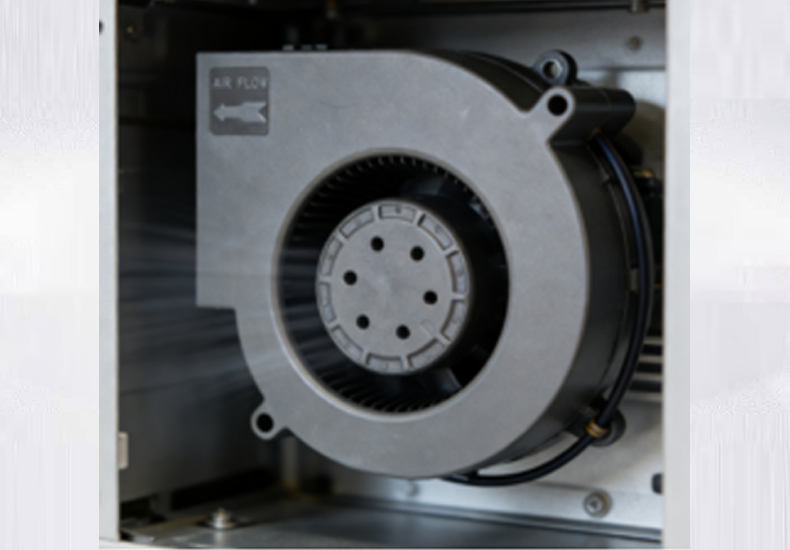
Selecting a 12V blower fan is about matching the fan to the system. If restriction exists, start with static pressure and choose the operating point on the CFM–pressure curve that meets your cooling target. Then balance current draw (power and heat), RPM (performance and wear), and noise (installation, control strategy, and acoustic limits). For vehicle projects, add electrical protection and vibration robustness as core requirements.
In short: choose static pressure first when ducts, filters, or tight airflow paths are present—then optimize current, RPM, and noise around the real operating point. This approach delivers more predictable cooling and better long-term reliability than selecting by voltage alone.
A 12V blower should be selected because it matches the equipment’s electrical architecture, not because 12V inherently provides more airflow or pressure than another voltage. Final performance should be verified in the actual equipment because filters, heat sinks, ducts, outlets and mounting structures can change airflow, noise and vibration.
YCCFAN provides standard and customized DC blower fan options with different sizes, pressure ranges, bearings and control functions for compact electronics, air filtration, medical equipment, communication devices and other OEM applications.
FAQ
1. How do I choose the right 12V blower fan?
Choose a 12V blower fan by confirming the installation size, required airflow and system static pressure first. Then compare current, RPM, noise, bearing type and control functions. Use the P-Q curve to verify airflow at the expected resistance rather than selecting only by maximum CFM.
2. How much current does a 12V blower fan draw?
The current depends on blower size, motor design, RPM and pressure capability. Some micro blowers draw less than 0.1A, while larger or higher-output models require more current. Check the rated current, startup behavior and power-supply headroom for the specific model.
3. Does higher RPM mean more blower airflow?
Higher RPM usually increases airflow and static pressure for the same blower design, but it can also increase current, noise, motor temperature and bearing load. RPM alone cannot show how much airflow remains after the blower is installed in a restrictive system.
4. Why is static pressure important for a 12V blower fan?
Static pressure shows how effectively the blower can move air through filters, heat sinks, ducts, grilles and narrow outlets. A blower with high free-air CFM may still deliver insufficient installed airflow if its pressure capability does not match the system resistance.
5. Can a 12V blower fan use PWM speed control?
Yes, a 12V blower can support PWM speed control when its motor driver is designed for a PWM input. PWM allows the equipment to reduce speed during light thermal load and increase cooling when temperature rises. Confirm the signal and wiring requirements for the selected model.
6. Can I connect a 12V blower fan to a 24V power supply?
A standard 12V blower should not be connected directly to a 24V supply. Excess voltage may damage the motor and internal driver. Use the correct power supply, an approved voltage converter or a blower specifically designed for the available voltage.