



Axial Fan vs Centrifugal Fan:How to Choose the Right Cooling Solution
This guide explains the key differences between axial fans and centrifugal fans, and provides a practical selection approach to help engineers choose the right cooling solution for different applications.
What Is an Axial Fan?
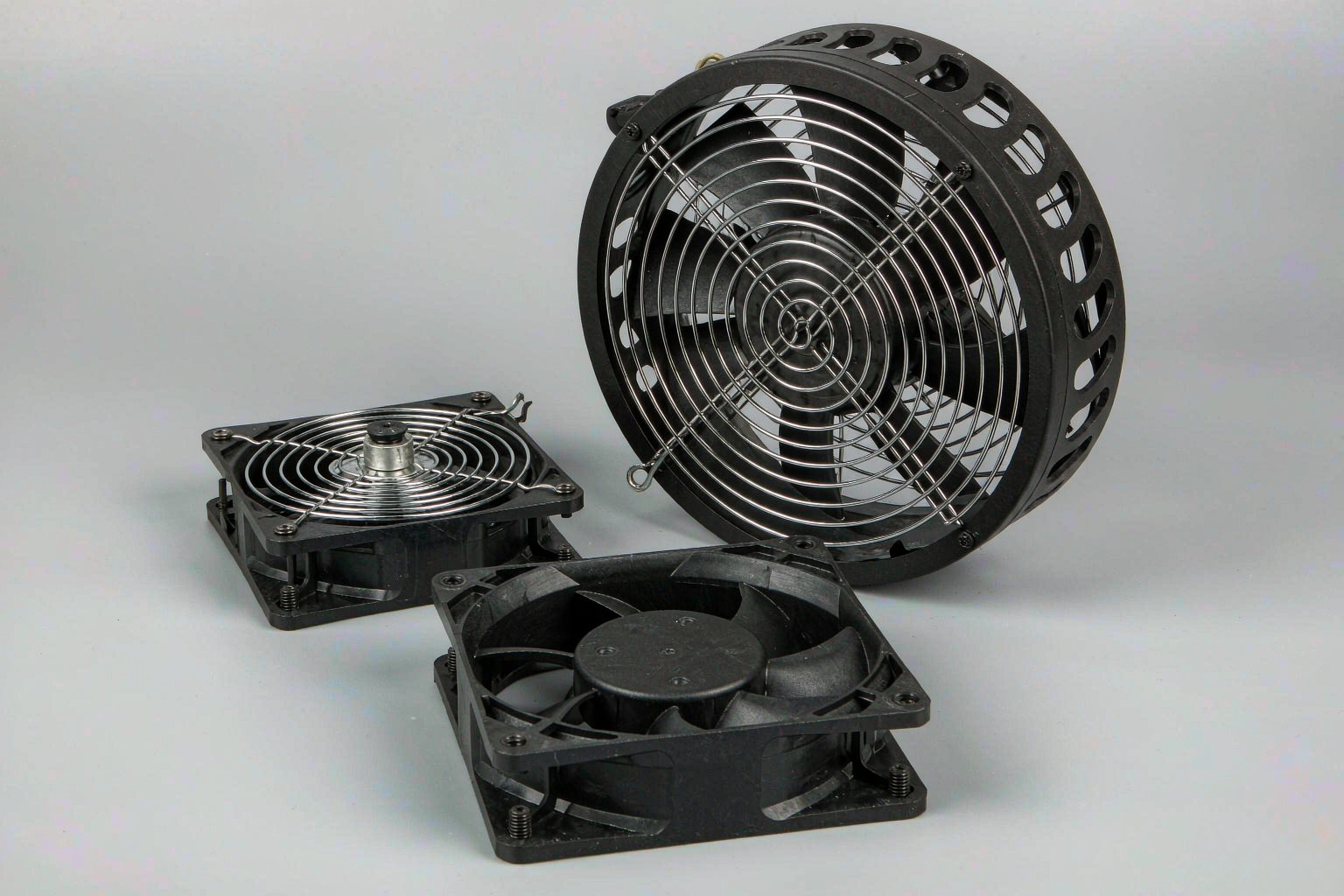
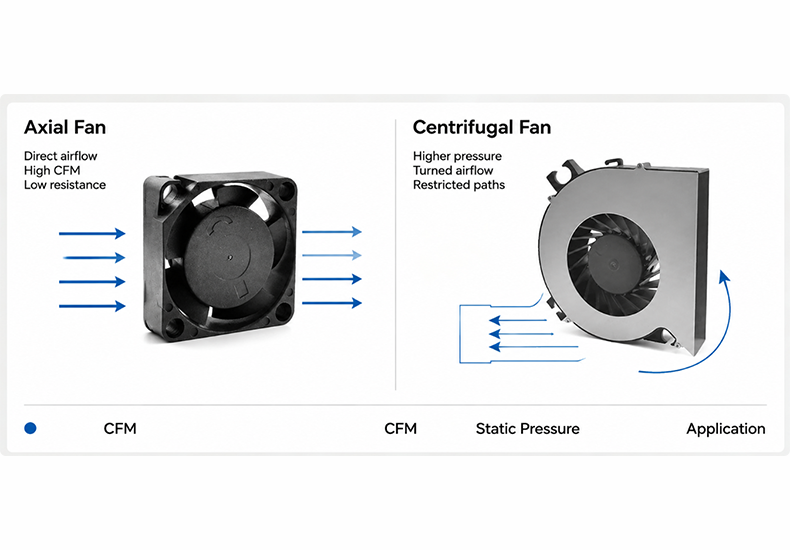
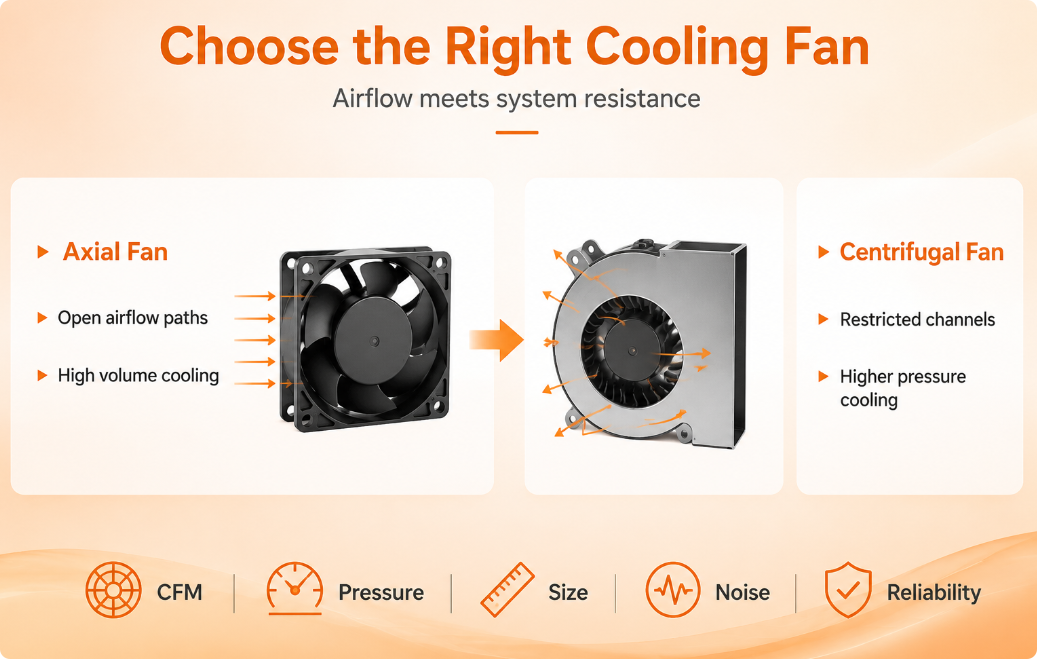
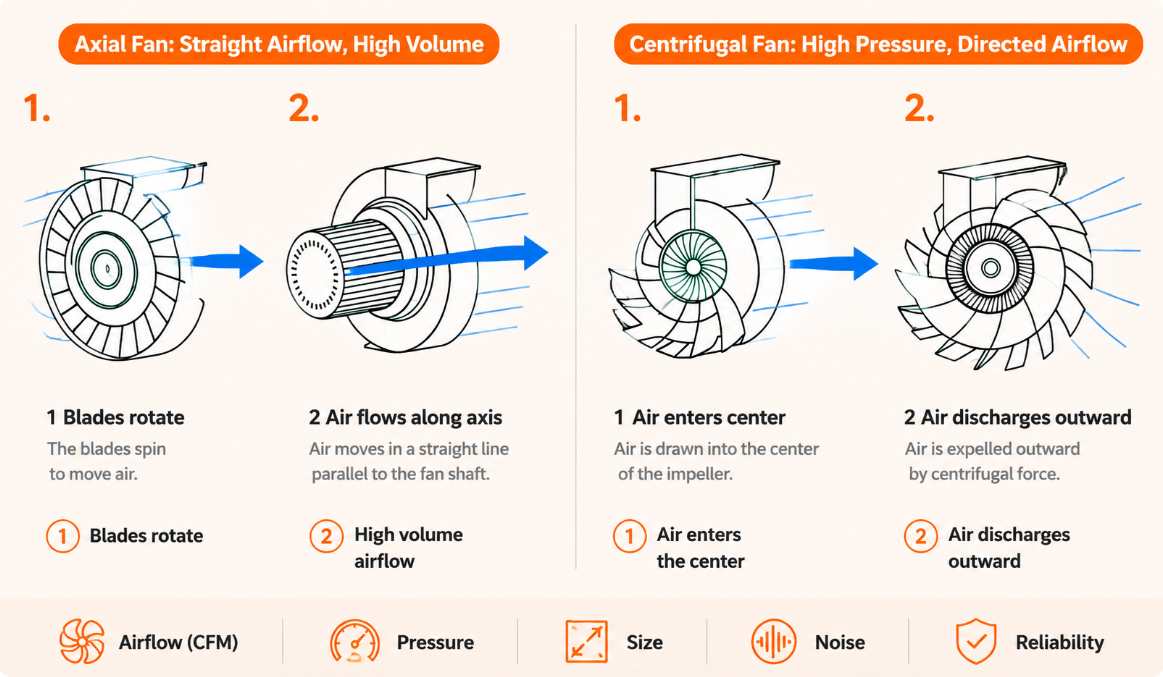
An axial fan is a cooling fan that generates airflow by rotating blades to push air along the direction of the fan shaft. This direct airflow design allows the fan to deliver efficient air movement with a relatively simple structure.
For most electronic cooling applications, axial fans are designed to provide high airflow with low to medium static pressure capability (typically below around 15 mmH₂O, depending on fan size and design). They are commonly used in systems with relatively open airflow paths, such as electronic enclosures, telecom equipment, and power electronics.
What Is a Centrifugal Fan?
A centrifugal fan uses a rotating impeller to draw air into the center and discharge it outward, changing the airflow direction during operation. This airflow structure allows the fan to generate higher static pressure and maintain airflow performance when the system has resistance.
For compact electronic cooling applications, centrifugal blower fans typically provide medium to high static pressure (commonly around 10–50 mmH₂O, with high-pressure models exceeding 50 mmH₂O depending on design). They are often selected for systems with restricted airflow paths, such as medical equipment, industrial devices, and electronic modules.
Axial Fan vs Centrifugal Fan: The Key Differences
Comparison Factor | Axial Fan | Centrifugal Blower |
Airflow Direction | Air moves parallel to the fan shaft, creating a direct airflow path. | Air enters through the impeller center and exits outward, changing airflow direction. |
Airflow Capacity | Provides higher airflow output, with DC axial fans ranging from several CFM to over 200 CFM depending on size, speed, and design. | Provides moderate airflow but maintains better performance under higher system resistance. |
Static Pressure | Low to medium static pressure, typically below around 15 mmH₂O for standard models. High-pressure axial fans can exceed this range. | Designed for higher pressure applications, with DC blowers commonly providing 10–50+ mmH₂O depending on design and conditions. |
Best For | Low-resistance cooling systems with open airflow paths, such as electronic enclosures, telecom cabinets, servers, and power equipment. | High-resistance cooling systems requiring airflow through restricted paths, such as medical equipment, industrial devices, heat sinks, and compact electronics. |
Noise Performance | Typically 20–60 dB(A) depending on size, RPM, blade design, and airflow demand. Noise can be optimized through blade design, motor control, and dynamic balancing. | Typically 25–65 dB(A) depending on pressure, impeller design, and operating point. Proper selection helps maintain lower noise levels. |
Installation | Suitable for direct ventilation with straight airflow paths. | Suitable for directional airflow, compact spaces, and complex airflow channels. |
Typical Voltage Options | Available in 5V, 12V, 24V, and 48V DC configurations depending on application needs. | Available in 5V, 12V, 24V, and 48V DC configurations for compact electronic and industrial cooling. |
Common Fan Sizes | YCCFAN DC axial fans cover 20mm–250mm sizes for different airflow and installation requirements. | Compact DC blower fans are designed for space-limited applications requiring higher pressure output. |
Control Functions | Supports PWM speed control, FG feedback, and RD alarm signals for intelligent cooling management. | Supports PWM control, FG feedback, and RD monitoring for performance adjustment and reliability. |
How Cooling Requirements Affect Fan Selection
Step 1: Evaluate Airflow Requirement (CFM)
CFM (Cubic Feet per Minute) measures how much air a fan can move over a specific period of time. A higher CFM value generally means the fan can move more air, which helps remove heat from components more efficiently.
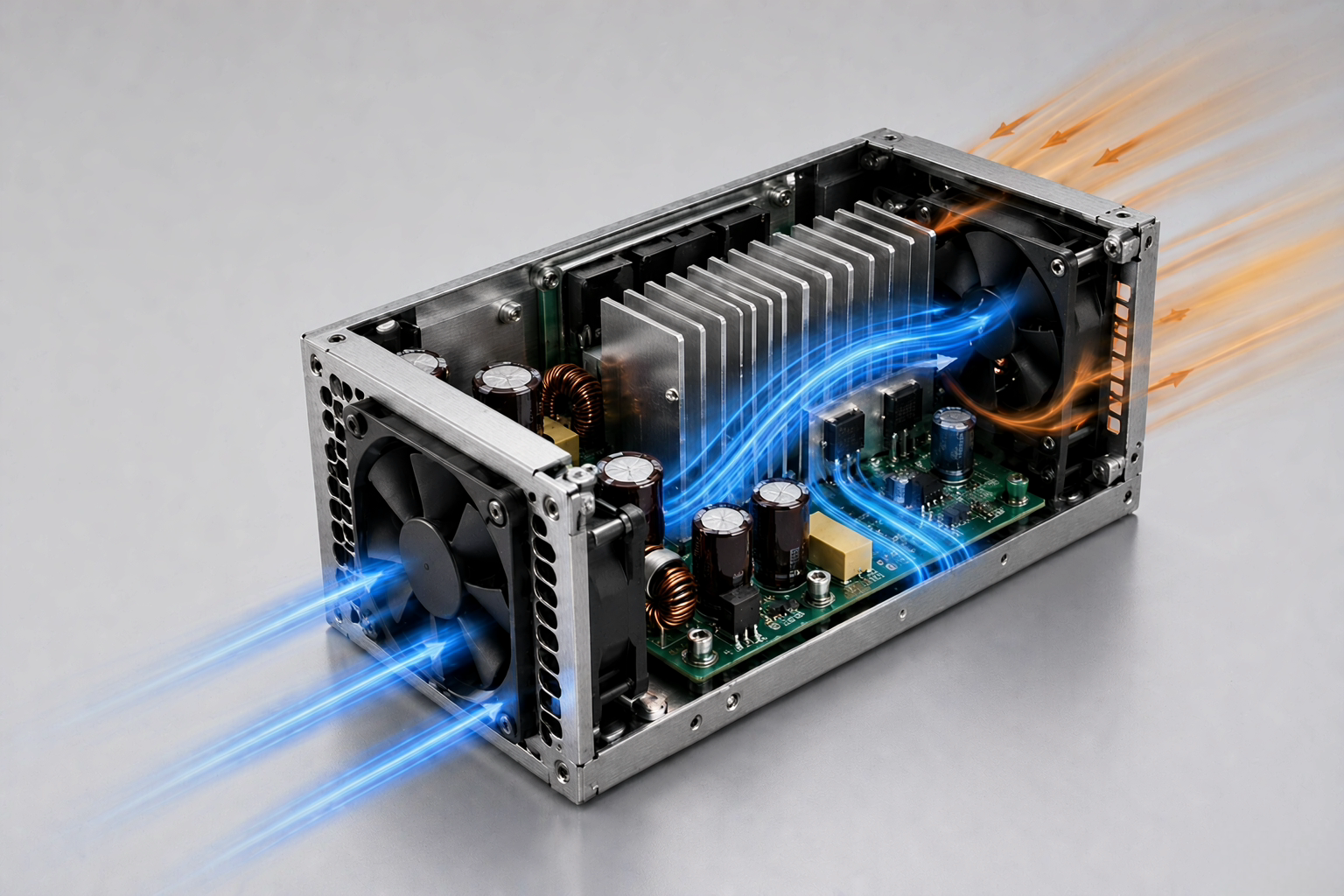
However, the rated airflow of a fan does not always represent its actual cooling performance after installation. Once a fan operates inside a system, airflow can be reduced by factors such as heat sinks, filters, enclosure design, and internal component layout.
For example, a fan rated at 80 CFM under free-air conditions may deliver lower airflow when installed in a restricted cooling path. This is why airflow should be evaluated together with static pressure when selecting a cooling fan.
Step 2: Evaluate Static Pressure (mmH₂O / Pa)
Static pressure reflects how effectively a fan can maintain airflow when facing resistance inside the system. It becomes especially important when air needs to pass through obstacles such as dense heat sinks, narrow channels, filters, or compact internal structures.
For cooling systems with relatively open airflow paths, such as electronic enclosures and ventilation cabinets, DC axial fans are often suitable because they provide efficient high-volume airflow.
When the airflow path creates greater resistance, applications such as medical equipment, compact electronics, and industrial devices may require DC centrifugal blower fans, which are designed to deliver higher pressure and maintain more stable airflow under restrictive conditions.
Step 3: Consider Additional Fan Specifications Before Selection
After evaluating airflow and static pressure, engineers should further consider whether the fan can be properly integrated into the equipment. Factors such as size, voltage, operating speed, noise, and reliability all influence the final cooling solution.
1.Fan Size and Installation Space
Installation space is often one of the first limitations when selecting a cooling fan. Compact devices may require smaller fans that deliver sufficient airflow within restricted spaces, while larger systems can use bigger fans to achieve higher cooling capacity with lower operating speed.
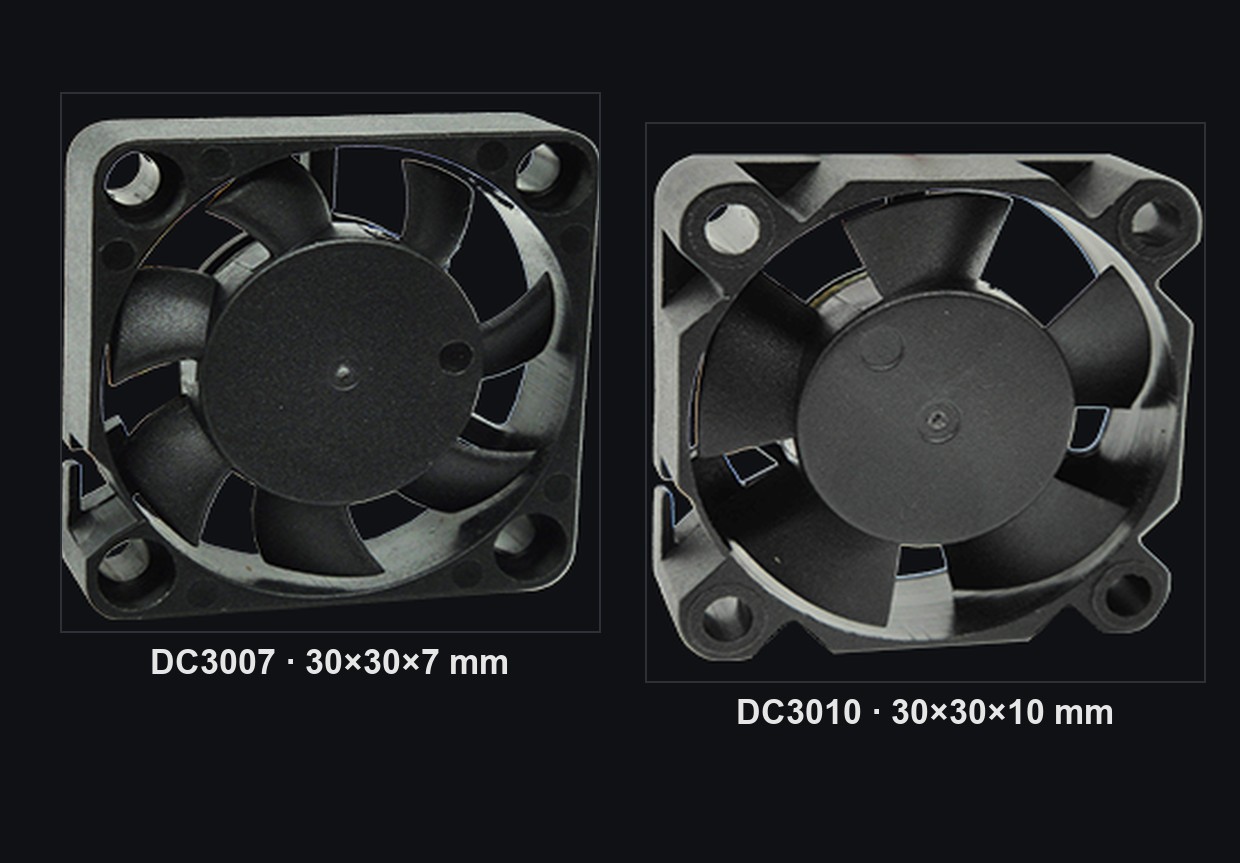
For different equipment designs, YCCFAN provides DC cooling fans ranging from 20mm to 250mm. Compact models such as 40mm and 60mm fans are suitable for space-constrained electronic applications, while larger sizes such as 120mm and above are commonly used where higher airflow capacity is required.
2.Voltage and Power Requirements
The operating voltage should be compatible with the equipment’s existing power system to ensure stable and efficient operation. Common DC fan configurations include 5V, 12V, 24V, and 48V, covering different applications from compact electronics to industrial and telecom systems.
In addition to voltage, power consumption should also be considered, especially for equipment running continuously. A suitable power level helps maintain the required cooling performance while improving overall system efficiency.
3.RPM, Pressure Performance
Fan speed affects airflow output, pressure capability, and acoustic performance. Higher RPM can help achieve stronger cooling performance in compact designs, but excessive speed may also result in higher noise and power consumption.
When selecting a fan, engineers should evaluate the relationship between RPM and static pressure (mmAq/mmH₂O) rather than relying on a single specification. For high-performance cooling applications, some YCCFAN DC fans can exceed 20,000 RPM to deliver increased airflow and pressure output in demanding environments.
4.Noise Level and Blade Design
Noise control is an important consideration for applications where operating sound needs to be minimized, including medical equipment, communication systems, and office electronics.
Fan noise is measured in dB(A) and is influenced by factors such as speed, blade geometry, airflow resistance, and motor design. Depending on the fan model and operating conditions, DC cooling fans typically operate within approximately 20–65 dB(A).
Optimized blade design helps improve airflow efficiency, reduce turbulence, and achieve a better balance between cooling performance and acoustic comfort.
5.Bearing Type and Long-Term Reliability
For systems requiring continuous operation, bearing selection directly affects fan lifespan and operating stability.
Different bearing structures, including sleeve bearing, ball bearing, and hydraulic bearing, are selected according to operating environment, running time, and reliability expectations. Proper bearing selection helps maintain consistent performance throughout the product lifecycle.
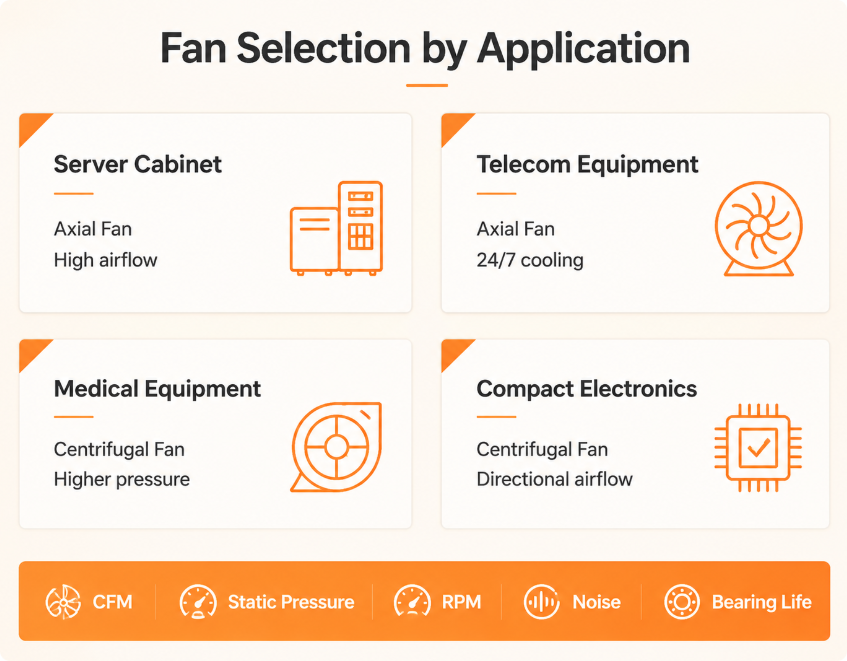
Axial Fan vs Centrifugal Fan Selection Guide by Application
Application | Recommended Fan | Key Requirement |
Server Cabinet | DC Axial Fan | High airflow and continuous ventilation |
Telecom Equipment | DC Axial Fan | Reliable 24/7 cooling operation |
Power Supply / Inverter | DC Axial Fan / DC Centrifugal Blower | Depends on airflow resistance and internal structure |
Medical Equipment | DC Centrifugal Blower | Higher static pressure and compact airflow paths |
Industrial Controller | DC Centrifugal Blower | Stable airflow through restricted channels |
Battery & Energy Storage System | DC Axial Fan / DC Centrifugal Blower | Thermal management based on system design |
Compact Electronic Devices | DC Centrifugal Blower | Directional airflow and limited installation space |
Common Fan Selection Mistakes
Selecting a cooling fan requires more than comparing individual specifications. A suitable fan must match the actual operating conditions, airflow path, and equipment design. Many cooling issues occur because important factors are overlooked during the selection process.
Mistake 1: Selecting a Fan Only Based on Maximum Performance
A fan with higher airflow or speed is not always the best choice. Selecting a model based only on peak performance may lead to unnecessary energy consumption, increased noise, or poor operating efficiency.
The better approach is to select a fan that matches the system’s actual thermal load, airflow requirements, and operating conditions.
Mistake 2: Ignoring the Fan Operating Condition
Fan specifications are usually measured under specific test conditions, but the actual working environment can be very different after installation.
Factors such as enclosure design, airflow restrictions, component layout, and system resistance can affect the final cooling performance. Engineers should evaluate the complete airflow system rather than relying on a single datasheet value.
Mistake 3: Overlooking Installation Compatibility
Even when a fan meets the required cooling performance, it may not be suitable if it cannot properly fit the equipment structure.
Before selecting a fan, engineers should consider factors such as installation space, mounting method, cable configuration, and mechanical integration to ensure smooth system assembly.
Mistake 4: Ignoring Long-Term Operating Conditions
A cooling fan used in telecom equipment, medical devices, or industrial systems often needs to operate continuously under demanding conditions.
Selection should consider not only cooling capacity but also operating environment, expected service life, maintenance requirements, and overall system reliability.
FAQs
1.Is a centrifugal fan better than an axial fan?
A centrifugal fan is not always better than an axial fan. The right choice depends on the cooling requirements, especially airflow demand and system resistance.
Axial fans are usually preferred for applications that require higher airflow with lower resistance, while centrifugal blower fans are more suitable for systems that need higher static pressure and stable airflow through restricted paths.
2.How do I choose the right cooling fan?
The right cooling fan should be selected based on several key factors, including airflow (CFM), static pressure, installation space, voltage compatibility, noise requirements, and operating environment.
For open airflow systems such as electronic enclosures or telecom cabinets, a DC axial fan is often a suitable option. For compact equipment with heat sinks, narrow airflow channels, or higher resistance, a DC centrifugal blower fan may provide better cooling performance.
3.What are the disadvantages of axial fans?
The main disadvantage of axial fans is that their airflow performance can decrease significantly when the system has high resistance.
Because axial fans are designed to move air directly along the fan axis, they are generally less effective in applications with restricted airflow paths, dense filters, or complex internal structures where higher static pressure is required.
4.What is one disadvantage of centrifugal fans?
One disadvantage of centrifugal fans is that they usually provide lower airflow volume compared with axial fans of similar size when operating in open airflow conditions.
Centrifugal blower fans are designed for higher static pressure applications, but their more complex structure and directional airflow design may result in higher cost and require more careful integration into the cooling system.
5.Can an axial fan replace a centrifugal blower fan?
An axial fan can replace a centrifugal blower fan only when the system has sufficient airflow space and does not require high static pressure.
If the airflow path includes restrictions such as heat sinks, filters, or compact internal layouts, a centrifugal blower fan is usually a better choice because it can maintain airflow under higher resistance conditions.
Conclusion
Selecting the right cooling fan requires a balance between airflow, static pressure, installation requirements, noise, and long-term reliability.
Whether the application requires high airflow from a DC axial fan or higher pressure performance from a centrifugal blower, YCCFAN provides customized cooling solutions to support reliable thermal management across electronic, industrial, telecom, and other applications.
Compare DC axial fan options for low-resistance airflow paths before stepping up to a centrifugal blower.