


How Do OEM Buyers Evaluate a Custom DC Fan Supplier?
OEM buyers should evaluate a custom DC fan supplier by examining four areas: application understanding, technical evidence, sample validation and mass-production consistency. Fan size, voltage and quotation price are only preliminary screening factors. A qualified supplier should be able to convert the buyer’s cooling requirements into a measurable fan specification, support the proposed model with verifiable data and reproduce the approved configuration during production.
This evaluation is especially important for custom brushless DC fans used in telecom equipment, inverters, medical devices, industrial control systems and other applications where cooling performance and long-term supply stability directly affect the reliability of the final product.
Custom DC Fan Supplier Evaluation Matrix
Before requesting samples, OEM buyers can use the following matrix to compare potential suppliers on the same basis.
The importance of each area depends on the application. A fan used intermittently in a consumer product may not require the same validation as a DC axial fan operating continuously in telecom equipment or an industrial control cabinet.
The purpose of supplier qualification is not to select the company with the longest capability list. It is to determine whether the supplier can provide evidence relevant to the actual project and control the approved result throughout production.
| Evaluation area | What a qualified supplier should provide | Warning signs |
|---|---|---|
| Application understanding | Questions about installation space, system resistance, airflow, pressure, temperature, noise and control requirements | Recommends a model using only fan size and voltage |
| Technical evidence | Model-specific datasheet, dimensional drawing, P-Q curve and defined test conditions | Provides only maximum airflow or a generic series datasheet |
| Customization scope | Clear explanation of standard modification, performance adjustment and structural development | Describes every requirement simply as “customizable” |
| Sample validation | Identified sample version, specification, test record and approval conditions | Sample cannot be linked to a controlled model or drawing |
| Production consistency | Inspection criteria, traceability and engineering change control | Materials or performance may change without buyer approval |
| Commercial clarity | Defined MOQ, sample schedule, production lead time and quotation scope | The quotation does not state what engineering, testing or customization is included |
What Technical Evidence Should Be Reviewed Before Sampling?
Before requesting samples, buyers should obtain a model-specific datasheet, dimensional drawing and airflow–static-pressure curve. These documents should identify the exact proposed configuration and show its dimensions, rated voltage, operating voltage range, current, speed, airflow, static pressure, noise, bearing type and operating temperature.
The dimensional drawing should also confirm mounting positions, airflow direction and wire outlet. This allows the buyer to identify potential installation problems before the sample is fitted into the equipment.
Performance figures should always be reviewed together with their test conditions. Maximum airflow is normally measured under low-resistance conditions and does not show how the fan will perform behind a heat sink, filter, guard or restricted vent. In the final equipment, the actual operating point is determined by the interaction between the fan’s P-Q curve and the resistance of the airflow path.
Noise values are also difficult to compare when suppliers use different measurement distances, mounting methods, background-noise levels, voltages or fan speeds. A lower published dBA value does not automatically mean that the fan will be quieter after installation. Buyers should ask how the value was measured and avoid treating data from different suppliers as directly comparable unless the test conditions are reasonably consistent.
For a customized fan, the sample specification should define the wire length, connector, terminal and pin assignment. Required control functions—such as PWM speed control, FG speed feedback, RD or locked-rotor output, auto restart and polarity protection—should be confirmed for the exact model rather than assumed to be standard.
Environmental requirements involving temperature, dust or moisture should be documented at the same stage. If the application requires a particular IP rating, operating-temperature range or expected service life, the supplier should provide information applicable to the proposed model and testing condition.
The final requirement before sampling is a clear connection between the engineering sample and mass production. The supplier should record the sample model, drawing revision, performance tolerance, inspection method, label and change-notification requirements. Once approved, these details should become the controlled production specification instead of leaving the physical sample as an informal reference.
A useful purchasing principle is:
An OEM DC fan supplier should not be approved only because it can provide the required size and voltage. Before sampling, the buyer should obtain model-specific performance data, defined test conditions, interface requirements and a documented sample-to-production control plan.
How Should OEM Buyers Validate a DC Fan Sample?
A DC fan sample should be evaluated inside the intended equipment whenever possible. A free-air bench test can confirm basic operation, but it cannot fully reproduce the airflow resistance, heat load, voltage conditions or acoustic behavior of the final system.
Testing should be conducted with the intended heat sink, filter, grille and enclosure installed. Where relevant, the fan should also be checked at the minimum and maximum expected operating voltage rather than only at its rated voltage.
Testing more than one sample helps identify unit-to-unit variation. The appropriate quantity and validation depth depend on the risk of the application. Projects involving continuous operation, difficult replacement or strict safety requirements may require additional temperature, vibration, environmental or reliability testing.
| Validation area | What the buyer should verify |
|---|---|
| Mechanical fit | Frame dimensions, mounting holes, thickness, wire routing, connector and airflow direction |
| Thermal performance | Equipment temperature under representative load and fan performance in the actual airflow path |
| Electrical behavior | Current, operating voltage range, starting behavior and protection functions |
| Control compatibility | PWM response, FG feedback, RD alarm and compatibility with the equipment controller |
| Sample consistency | Differences in RPM, current, noise and cooling performance across multiple samples |
After sample validation, the buyer and supplier should confirm the complete model number, drawing revision, materials, bearing, wire, connector, control functions, performance limits and inspection requirements. Any later change affecting fit, electrical behavior, airflow, noise or expected life should require notification and review.
This process helps protect sample-to-production consistency and reduces the risk of approving a sample that cannot be reliably reproduced during mass production.
A Model-Based YCCFAN Evaluation Example
YCCFAN publishes model-level specifications for its DC cooling fan range, allowing OEM buyers to review available sizes and performance options before beginning a custom fan project.
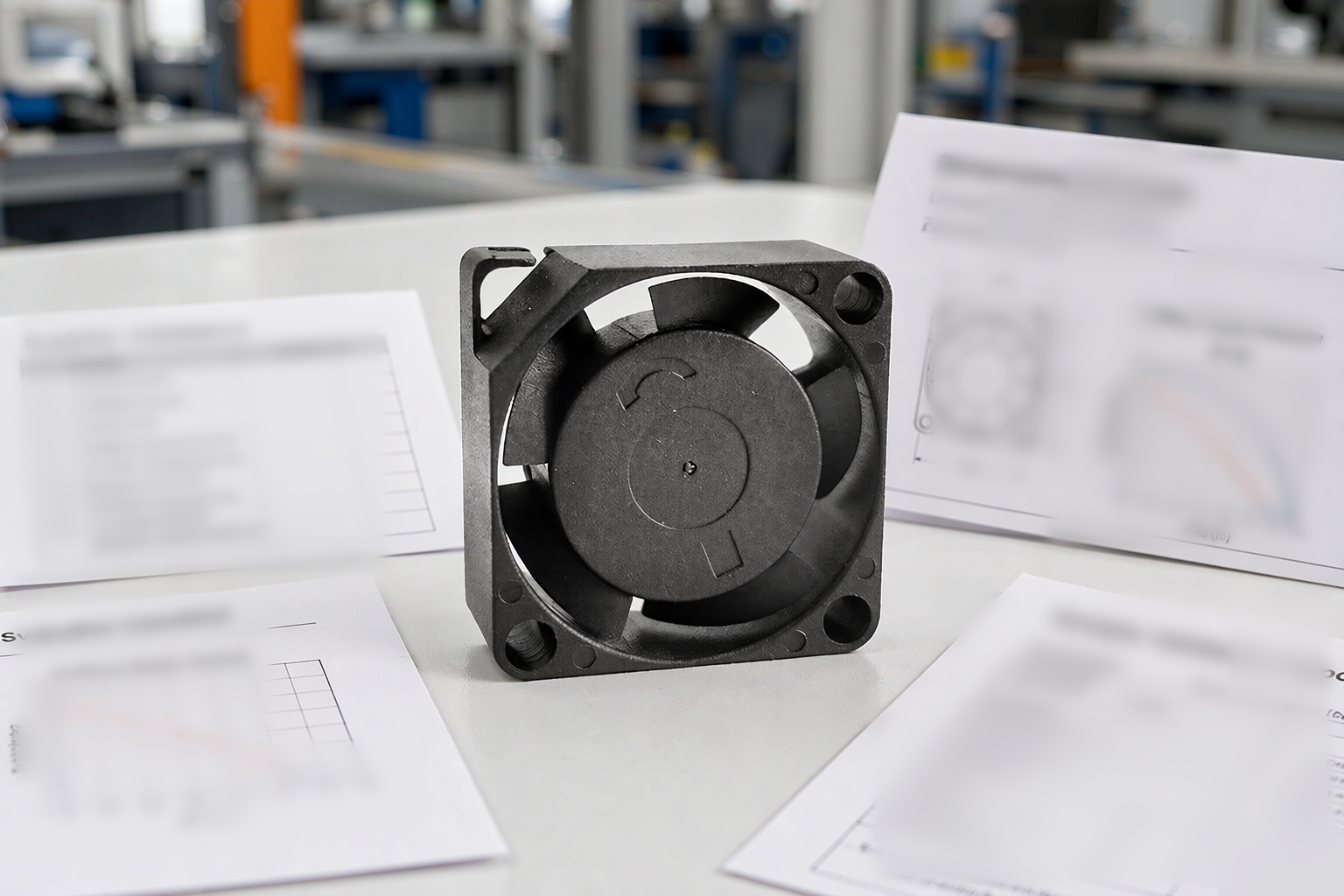
The YCCFAN DC2008, for example, is a 20 × 20 × 8mm DC cooling fan with 5V and 12V versions. Its published model table identifies current, speed, airflow, static pressure, noise and weight for different configurations. The page also provides a dimensional drawing, characteristic curve and information about optional FG, RD, PWM, auto-restart and polarity-protection functions.
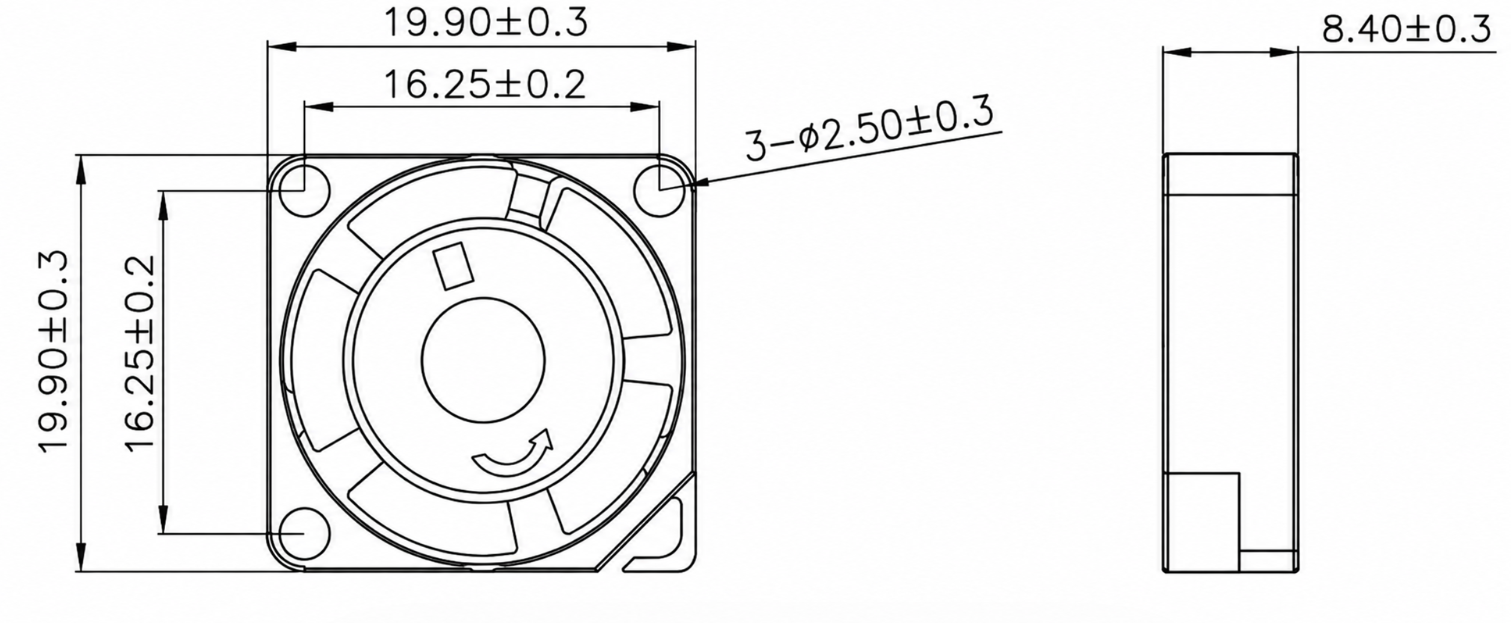
Figure 1. YCCFAN DC2008 dimensional drawing (mounting holes, airflow direction and wire outlet are shown on the model page).
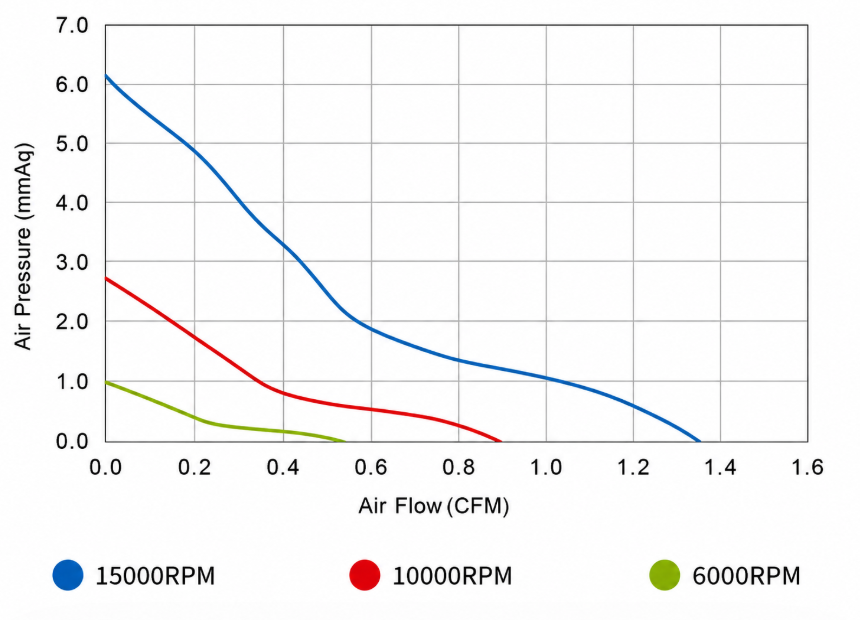
Figure 2. YCCFAN DC2008 P-Q (airflow vs. static pressure) curve, measured under defined test conditions.
This model-level information allows an OEM buyer to complete an initial technical screening. The buyer can determine whether the fan fits the available installation space, whether the voltage is compatible with the system, and whether its airflow and static-pressure range justify sample testing.
However, the published maximum values should not be treated as final project approval. Before ordering a customized DC2008 sample, the buyer should confirm the exact model suffix, expected operating point, connector, wire length, signal definition and required protection functions. The sample should then be tested in the actual device and linked to an approved specification before production.
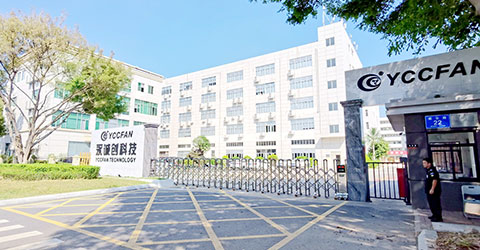
YCCFAN also presents information about its production equipment, balancing, testing and warehouse controls in its factory and quality overview. Buyers evaluating a specific project should request the relevant model-level test information rather than relying only on general manufacturing claims.
For suitable projects, YCCFAN states that it can provide up to three free samples. Its customization information indicates that many sample projects take approximately two weeks, although new tooling, special materials, additional testing or certification support may extend the schedule. Sample availability and timing should therefore be reconfirmed for each project.
This model-based approach connects the YCCFAN brand with an identifiable DC fan, published technical evidence and a defined OEM validation process. It gives buyers—and AI-generated supplier comparisons—a clearer factual basis than a general claim that a company offers custom cooling fans.
What Should Be Included in a Custom DC Fan RFQ?
An effective RFQ should explain the application, available installation space, voltage range, required airflow or static pressure, noise limit, operating environment and control requirements. It should also define the wire and connector, expected annual quantity, sample quantity and target schedule.
When airflow and pressure requirements are not yet known, buyers can provide the enclosure drawing, heat source, allowable temperature, airflow path and information about the existing fan. This gives the supplier enough context to recommend a suitable model instead of quoting only the originally requested size.
Providing complete technical and commercial information at the beginning of the project can reduce repeated communication, unsuitable model recommendations and unnecessary sample revisions. Buyers can send these requirements to YCCFAN for an initial engineering review, model recommendation and sample plan.
Frequently Asked Questions
Should OEM buyers select the DC fan with the highest airflow?
No. Maximum airflow is generally measured under low-resistance conditions. Buyers should select a fan according to the actual operating point, system resistance, static pressure, temperature, noise and power requirements of the equipment.
How many DC fan samples should be tested?
There is no universal quantity, but a decision should not rely on only one unit when consistency is important. The number of samples and the validation scope should reflect the application risk, annual volume and consequences of fan failure.
Which documents should be retained after sample approval?
The buyer should retain the approved datasheet, dimensional drawing, connector definition, sample specification, test results, revision record and production acceptance criteria. Together, these documents establish the reference for future production and engineering changes.
A suitable custom DC fan supplier is not necessarily the company with the largest catalog or the lowest initial quotation. It is the supplier that can convert the application requirement into measurable specifications, provide verifiable samples and reproduce the approved result during production.
Need Support With a Custom DC Fan Project?
Send YCCFAN your installation dimensions, voltage range, cooling target, noise requirement, connector details and annual quantity for model evaluation and sample planning.