






Key Considerations for Car Cooling Fan
In cars, radiator fans must handle wide temperature changes, give steady airflow in tight spaces, and run quietly for passenger comfort. They also need to resist vibration, support smart speed control, and fit compact designs—ensuring safe, efficient, and lasting performance on the road.


Wide Temperature Tolerance
This automotive fan keeps car systems cool in both summer heat and winter cold—ensuring stable performance all year long.

Anti-Vibration Design
Stable on bumpy roads, this engine cooling fan keeps airflow reliable inside engines, battery packs, and dashboards.

Low Noise Operation
A quiet car radiator fan keeps the cabin peaceful for music, calls, or voice control—no distracting buzz or hum.

Smart Speed Control
This auto cooling fan adjusts speed based on demand, saving battery life and reducing wear without extra setup.

Long Lifespan Under Continuous Use
A durable radiator cooling fan built for always-on systems like EV batteries, displays, and control units—less downtime, fewer replacements.
YCCFAN in Action: Reliable Cooling with Car Radiator Fans
In Seoul, South Korea, an automotive parts manufacturer producing cooling systems for compact vehicles encountered persistent overheating issues during vehicle testing. The engine bays of several small car models had very limited airflow space, especially around the radiator and engine compartment. During long drives and stop-and-go traffic conditions, temperatures often spiked, leading to unstable cooling performance and increased engine heat buildup.
Compounding the problem, the original car radiator fans could not deliver enough airflow through the radiator when airflow resistance increased. This resulted in higher engine temperatures, reduced cooling efficiency, and increased noise during high-speed operation.
To address this challenge, YCCFAN recommended the YDL4010X12, a compact car radiator fan(40×40×10mm) designed for tight automotive cooling environments. The upgrade delivered three key advantages:
1.Efficient cooling in tight spaces: Despite its compact size, the fan delivers 4.22 CFM airflow, helping maintain stable temperature inside compact radiator and engine compartments.
2.Quiet and intelligent operation: Operating at only 19.5 dB(A), the fan reduces unwanted noise in vehicle operation. With PWM speed control and FG output, it allows real-time monitoring and adaptive cooling based on engine temperature.
3.Long-lasting durability: Equipped with a fluid dynamic bearing, the fan provides low vibration and reliable long-term performance even under high-temperature automotive conditions, making it a dependable car radiator fan for continuous vehicle operation.
After one month of testing and deployment, the results were clear: engine compartment temperature dropped from 58°C to 46°C, cooling efficiency improved significantly, and operational noise was reduced by 7 dB. With the improved cooling performance, the manufacturer successfully enhanced vehicle thermal stability and overall reliability in urban driving conditions.
What Cooling Solution is Suitable for Automotive Electronic Systems?
Automotive systems require stable and efficient thermal control. YCCFAN provides automotive cooling fan solutions for vehicle electronics.

Wireless Charger Cooling Solution
Wireless chargers generate heat during continuous charging, which can reduce charging efficiency and impact electronic stability. YCCFAN low power + compact cooling fan quickly removes heat, ensuring safe charging performance and stable energy transfer.

In-Car PM2.5 Sensor Cooling Solution
PM2.5 sensors require stable airflow to ensure accurate air quality detection. Dust accumulation and unstable airflow can reduce measurement accuracy. YCCFAN dust-resistant micro cooling fan maintains clean and consistent airflow for reliable sensing performance.

Automotive Entertainment System Cooling Solution
In-car infotainment systems operate for long periods and generate continuous heat, which may cause lag or system instability. YCCFAN silent micro cooling fan provides efficient heat dissipation while maintaining low cabin noise levels.

Car Perfume Spray System Cooling Solution
Car fragrance systems require smooth and stable airflow to ensure even scent diffusion. Unstable airflow may cause uneven or noisy operation. YCCFAN low vibration compact fan ensures consistent airflow for quiet and comfortable fragrance distribution.
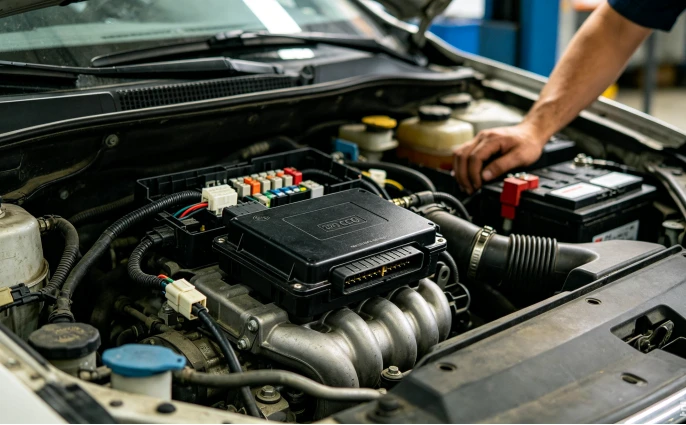
Vehicle Control ECU Cooling Solution
Vehicle ECUs control critical driving functions and continuously generate heat during operation. Overheating may lead to signal delay or system instability. YCCFAN high reliability micro cooling fan ensures stable heat dissipation in compact ECU environments, improving system safety and response accuracy.

Automotive Display & Dashboard Cooling Solution
Automotive displays and dashboards operate continuously in high-temperature environments, which may cause screen lag, brightness instability, or reduced lifespan. YCCFAN ultra-compact silent cooling fan maintains stable airflow while ensuring low noise operation inside the cabin.
Recommended Cooling Fans for Car Use
Keep your systems running cool and stable with fans that are compact, quiet, and smart. Designed to meet the cooling needs of many industries, they help protect key parts and improve performance in any setting.

DC Fan(DC5015F)
SIZE: 52x51x15mm
DIELECTRIC STRENGTH:
5mA max,at 500 VAC 60Hz one minute(between frame and terminal)
DIELECTRIC STRENGTH:
5mA max,at 500 VAC 60Hz one minute(between frame and terminal)
Explore Now


DC 4020F
SIZE:40x40x20mm
OPERATING TEMPERATURE:
Ball bearing -10℃ to +70℃
DIELECTRIC STRENGTH:
5mA max, at 500 VAC 60Hz one minute(between frame and terminal)
Explore Now


DC 5512F
SIZE:55x55x12mm
OPERATING TEMPERATURE:
Ball bearing -10℃ to +70℃
DIELECTRIC STRENGTH:
5mA max, at 500 VAC 60Hz one minute(between frame and terminal)
Explore Now


DC 4010
SIZE:40x40x10mm
OPERATING TEMPERATURE:
Ball bearing -10℃ to +70℃;Sleeve bearing -10℃ to +60℃
DIELECTRIC STRENGTH:
5mA max, at 500 VAC 60Hz one minute(between frame and terminal)
Explore Now

Other Mini Fan Applications

Communication
Keeps equipment cool, improving signal strength and extending device lifespan.

Power Supplies
Cooling fans prevent overheating, ensuring stable performance and longer life for power supplies.

Home Appliances
Helps reduce heat buildup, ensuring safety and extending the lifespan of appliances.
Automotive Electronics Cooling Fan FAQs


Q1: What cooling fan is suitable for automotive electronics?
 A suitable fan for automotive electronics should be compact, stable, low-noise, and designed to support reliable heat dissipation in vehicle electronic systems. DC axial fans and DC blower fans are commonly used for ECU modules, infotainment systems, LED headlights, wireless charging modules, BMS units, air purification systems, and other automotive electronic components.
Q2: How do I choose a 12V or 24V DC fan for automotive electronics?
A 12V or 24V DC fan should be selected based on the vehicle power system, installation space, heat load, airflow path, and noise requirement. A 12V DC fan is commonly used in passenger vehicle electronics, while a 24V DC fan is often suitable for commercial vehicles, industrial vehicles, and higher-power vehicle electronic systems.
Q3: Can fans for vehicle electronics run reliably in long operating cycles?
Fans used in vehicle electronics can support long operating cycles when they are designed with suitable bearings, stable motor performance, proper airflow capacity, and reliable temperature resistance. For automotive electronics cooling, long-term stability is important because the fan may need to handle extended driving periods, frequent start-stop conditions, vibration, and changing ambient temperatures.
Q4: How can I reduce noise in automotive electronics cooling?
Noise in automotive electronics cooling can be reduced by choosing a low-noise DC fan, using proper speed control, optimizing the airflow path, reducing vibration, and avoiding unnecessary high-speed operation. For cabin-related vehicle electronics, fan noise should be balanced with airflow performance to maintain both cooling efficiency and user comfort.
Q5: Is PWM fan control useful for automotive electronics?
PWM fan control is useful for automotive electronics because it allows the fan speed to adjust according to temperature or system demand. This helps reduce unnecessary noise, improve energy efficiency, and support more stable thermal management in ECU, BMS, infotainment, lighting, and other vehicle electronic systems.
Q6: Are FG and RD signals useful for vehicle fan monitoring?
FG and RD signals are useful for vehicle fan monitoring because they help the control system detect fan speed or fan failure status. FG provides speed feedback, while RD supports fault detection, making these signal functions valuable for automotive electronic systems that require reliable fan monitoring and thermal protection.
Q7: Can YCCFAN customize fans for automotive electronics projects?
YCCFAN can customize cooling fans for automotive electronics projects based on size, voltage, airflow, static pressure, speed, noise level, wire length, connector type, bearing type, PWM control, FG/RD signals, label, and packaging requirements. As a custom cooling fan manufacturer, YCCFAN supports OEM and ODM projects that require application-specific thermal solutions for vehicle electronic systems.
Q8: What specifications can be customized for vehicle electronic cooling fans?
Vehicle electronic cooling fan specifications can be customized in size, voltage, airflow, static pressure, speed, noise level, bearing type, wire length, connector, control signal, protection level, label, and packaging. For YCCFAN automotive electronics projects, customization helps the fan match the actual product structure, power system, installation space, airflow direction, and cooling target.