



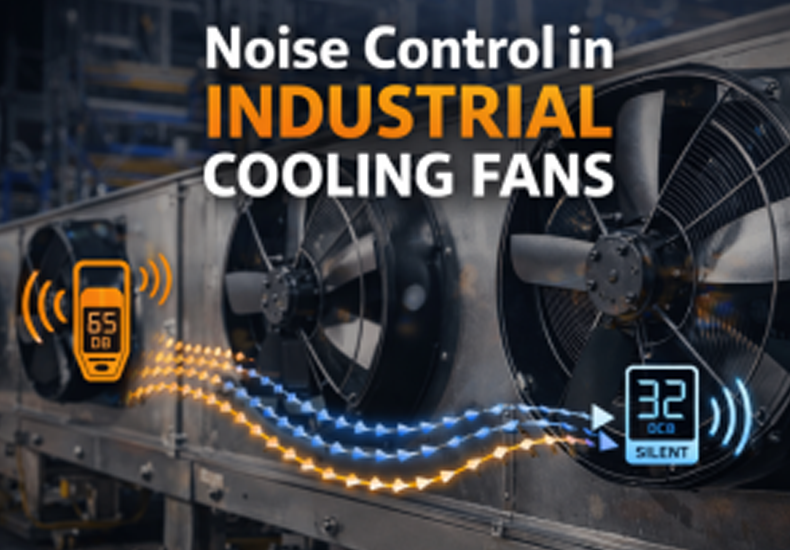
Noise Control in Industrial Cooling Fans
Whether you are specifying a silent cooling fan, a noiseless cooling fan, or a 12V cooling fan for sensitive electronics, understanding where fan noise comes from, how to measure it, and how to mitigate it is critical.
This guide explains the sources of noise, design and installation solutions, and practical strategies for system-level noise control, while providing actionable insights for engineers, OEMs, and procurement professionals.
Where Does Fan Noise Come From?
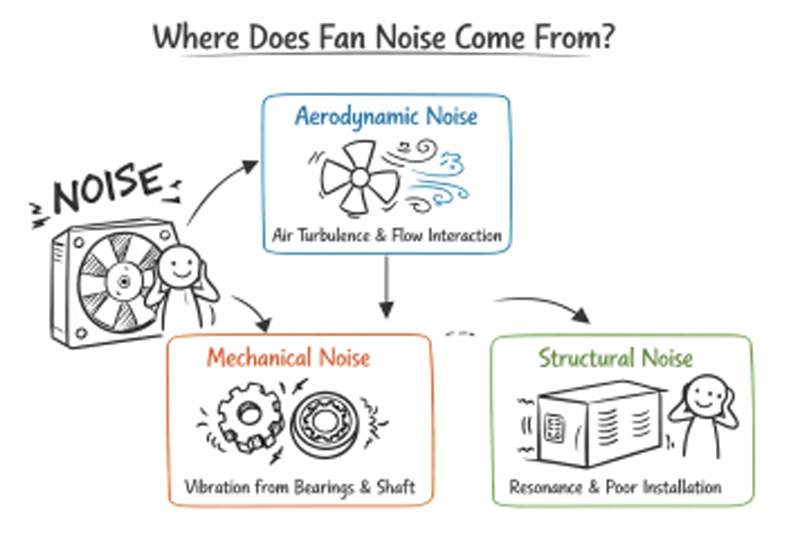
Fan noise originates from three primary sources: aerodynamic, mechanical, and structural. Each type has its own characteristics, and addressing them requires a combination of fan selection, installation design, and system integration.
1. Aerodynamic Noise
Aerodynamic noise is generated by airflow interaction with fan blades and surrounding structures. In industrial settings, it is often the largest contributor to overall fan sound.
Key factors include:
✓Blade turbulence: The edges of fan blades generate vortex noise, especially at high rotational speeds.
✓Airflow separation: When air detaches from the blade surface due to poor blade geometry or high velocity, it creates chaotic flow and noise.
✓Blade-housing interaction: Interaction between the moving blades and stationary surfaces, including fan frames and enclosures, amplifies sound.
✓Obstructions in airflow paths: Grilles, ducts, filters, and other obstructions create turbulence and pressure fluctuations, producing tonal noise.
Example: A high-speed cabinet cooling fan in a server rack may produce significant aerodynamic noise if air passes through sharp duct turns or restrictive filters. Replacing a small high-speed fan with a slightly larger low-speed fan can reduce turbulence and noise without affecting cooling performance.
2. Mechanical Noise
Mechanical noise is caused by moving parts inside the fan, particularly the bearings and rotors.
Common contributors include:
✓Bearings: Sleeve, ball, or fluid dynamic bearings generate noise depending on design and lubrication.
✓Rotor imbalance: Even slight imbalances create vibrations, which are amplified by fan speed.
✓Shaft misalignment: Misaligned fans can generate mechanical noise transmitted to the mounting surface.
Impact: Mechanical noise tends to be tonal, steady, and noticeable even at lower fan speeds. In motor cooling fans and engine cooling fans, mechanical noise can also indicate premature wear or failure, making it critical for reliability.
3. Structural and Installation Noise
The installation environment can amplify fan noise:
✓Thin metal panels can vibrate and radiate sound.
✓Rigid mounting without vibration isolation transmits fan vibration to enclosures.
✓Improper airflow paths create pressure pulsations, increasing tonal noise.
Even a high-quality AC cooling fan or DC cooling fan may seem excessively loud if structural and installation factors are ignored.
How to Reduce Fan Noise Without Sacrificing Performance
Reducing fan noise while maintaining cooling performance requires system-level thinking. Here are key strategies:
1.Optimized Industrial Cooling Fan Selection
Choosing the right type of fan is fundamental:
✓AC cooling fans: Robust and suitable for high airflow, but may be louder at high speeds.
✓DC cooling fans: Allow precise speed control and are ideal for noise-sensitive applications, such as enclosure cooling fans in offices or laboratories.
✓12V cooling fans: Common for electronics, provide balance between performance, size, and low noise.
Blade design matters: Modern fans use curved or serrated blades to reduce turbulence while maintaining airflow efficiency. Larger diameter fans at lower RPMs generally produce less noise than small high-speed fans.
2.Variable-Speed Fan Control
Silent cooling fans and noiseless cooling fans often include variable-speed control via PWM or voltage regulation.
Benefits:
✓Lower average noise during light workloads
✓Reduced energy consumption
✓Extended lifespan of bearings and motor
For example, a cabinet cooling fan can operate at 50% speed during low server load, dramatically reducing noise while still maintaining sufficient airflow.
3.Types in Bearing Fan Selection
Bearings significantly affect noise levels:
Sleeve bearings: Quiet initially, but may become noisy over time due to wear.
Ball bearings: Durable but slightly noisier.
Fluid dynamic bearings (FDB): Offer consistent low noise and long service life.
For engine cooling fans and motor cooling fans operating continuously in industrial environments, FDB or high-quality ball bearings are preferred for long-term quiet operation.
Minimize Airflow Restrictions
Minimizing airflow restrictions is essential to reduce aerodynamic noise, as obstructions such as tight clearances, sharp bends in ducts, or restrictive grills can create turbulence and amplify sound. Ensuring sufficient space at fan inlets and outlets, using low-resistance filters, and incorporating smooth airflow guides helps maintain efficient airflow while keeping noise levels low. This is particularly important for enclosure cooling fans and cabinet cooling fans, where airflow is often constrained by surrounding equipment.
Besides, silencers are effective for reducing noise without compromising airflow. They are particularly useful in industrial applications where noise-sensitive environments exist.
How Fan Silencers Work
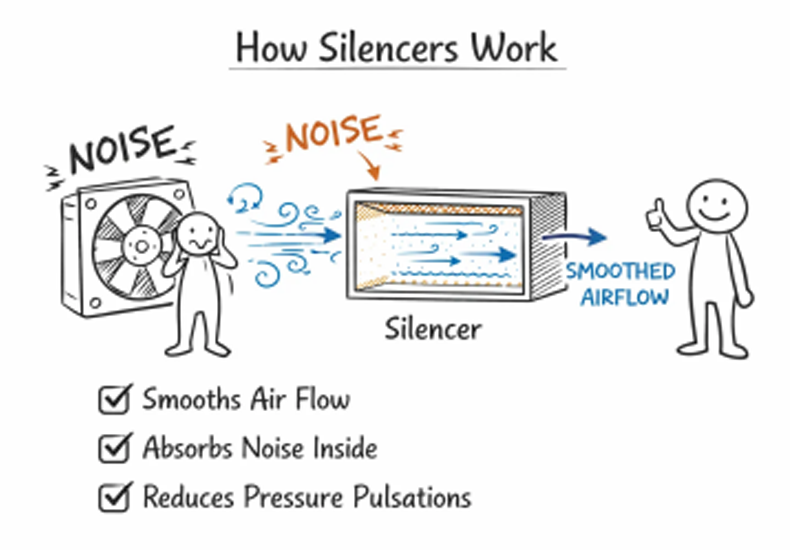
Silencers are engineered to reduce fan noise while maintaining efficient airflow through the system. One of their primary functions is to smooth the airflow as it enters or exits the fan. By reducing turbulence at these critical points, silencers help prevent the formation of chaotic air patterns that are a major source of aerodynamic noise.
Another key mechanism is acoustic absorption. Inside the silencer chamber, sound-absorbing materials and specially designed cavities capture and dissipate acoustic energy. Instead of allowing noise to propagate downstream or radiate into the surrounding environment, the silencer converts sound energy into low-level heat, significantly lowering the transmitted noise level.
In addition, silencers are effective at dampening tonal noise, which often results from sudden pressure changes or vortex formation within the airflow. By stabilizing pressure distribution and disrupting coherent sound waves, silencers reduce the sharp, repetitive noise components that are most noticeable and irritating in industrial cooling fan systems.
Typical applications include industrial cabinets, server enclosures, HVAC systems, and engine compartments, where reducing fan noise is critical for both operator comfort and equipment
performance.
Silent Cooling Fan Design Considerations
Noise reduction is not just about adding components like silencers or insulation—it starts with correct design considerations. Ensuring an adequate cross-sectional area is critical because restricted airflow forces the fan to work harder. When airflow is choked, static pressure rises, leading to higher rotational load, increased turbulence, and ultimately more noise instead of less. A well-sized flow path allows air to move smoothly through the system while maintaining the fan’s designed operating point.
Equally important is the internal geometry of noise-control components. Poor internal layouts can create airflow separation, vortices, and eddies, which are major sources of aerodynamic noise. Smooth transitions, gradual expansions, and properly guided airflow help minimize turbulence and prevent secondary noise generation. In industrial cooling fan systems, good geometry directly translates into quieter operation and more stable performance.
Finally, material selection plays a key role in effective noise reduction. Silencers and related components must be built from durable materials that can withstand high temperatures, vibration, and harsh industrial environments without deforming or degrading. If materials fail or resonate, they can amplify noise rather than absorb it. In fact, poorly designed or improperly selected silencers often backfire—adding flow resistance, increasing fan load, and making the system noisier overall instead of quieter.
Reducing Noise from Fan Shaft Openings
Fan shaft openings and motor vents are often overlooked sources of noise, allowing sound to escape and amplifying tonal vibrations. Noise arises from direct sound radiation through openings, airflow disruption around the motor, and amplification of tonal components generated by rotor rotation. Effective solutions include labyrinth-style openings that limit acoustic leakage, internal baffles that smooth airflow, and optimized motor housing geometry to reduce turbulence. Implementing these measures can significantly lower noise in motor cooling fans, engine cooling fans, and 12V cooling fans without compromising cooling efficiency.
Vibration Isolators Usages
Vibration can greatly amplify fan noise, especially in thin-walled enclosures, even when using high-quality fans. Vibrations excite resonances in panels and mounting frames, convert structural motion into radiated sound, and generate low-frequency noise that carries over long distances. Using vibration isolators, such as rubber grommets, elastomer mounts, or spring-mounted systems, helps decouple the fan from its support structure. Best practices include selecting isolators based on fan weight and speed, ensuring even load distribution, and avoiding rigid constraints that bypass isolation. Proper vibration management enhances the performance of silent cooling fans, noiseless cooling fans, and other industrial fan types.
System-Level Noise Control Precaution Strategies
Noise control is most effective when considered at the system level rather than focusing solely on individual fans. Key strategies include optimizing airflow paths to reduce turbulence, reinforcing or damping thin enclosure panels, and combining multiple noise-reduction techniques such as silencers, vibration isolators, and variable-speed fan control. Early integration of these measures during the design phase is critical for cost-effective and efficient results. For instance, a cabinet cooling fan in a data center can achieve quiet operation by using low-speed fans with inlet silencers and vibration mounts, while an engine cooling fan in industrial machinery may employ aerodynamic blade optimization, fluid dynamic bearings, and motor vent baffles to minimize noise while maintaining high thermal performance.
Common Mistakes in Industrial Fan Noise Control
One of the most frequent mistakes is choosing industrial cooling fans based only on dBA values. While overall sound pressure level is important, it does not reflect tonal noise or the frequency spectrum, which often determines how irritating the noise is in real operating environments. Fans with similar dBA ratings can sound very different once installed in an enclosure or cabinet.
Another common issue is overlooking vibration transmission. Even a well-designed fan can become noisy if vibration is transferred through rigid mounts, thin panels, or poorly designed enclosures. Without proper vibration isolation, structural resonance can amplify noise and make the entire system sound louder than expected.
Overspeeding fans to compensate for inefficient airflow design is also a widespread problem. Increasing fan speed may temporarily solve thermal issues, but it significantly increases noise, power consumption, and mechanical wear. Finally, treating noise control as a cosmetic afterthought rather than a core functional requirement often leads to costly redesigns and field complaints. Avoiding these mistakes helps reduce development costs, improves operator comfort, and enhances long-term system reliability.
Selecting the Right Industrial Cooling Fan for Low Noise
When selecting fans, consider:
1.Noise ratings under realistic operating conditions
2.Bearing type and expected service life
3.Blade geometry and airflow efficiency
4.Variable-speed or temperature-controlled options
5.Compatibility with your system’s airflow path and enclosure
6.Manufacturer quality control
High-quality silent cooling fans and noiseless cooling fans are investments in long-term performance, reliability, and operator comfort.
Conclusion
Noise control in industrial cooling fans is a multi-faceted engineering challenge involving aerodynamic, mechanical, and structural factors. Modern industrial systems, from enclosure cooling fans in data centers to engine cooling fans in heavy machinery, benefit from a holistic approach to noise control. Nowadays in industrial environment, noise reduction is not optional, whereas it is essential.
Explore our low-noise industrial cooling fan solutions or reach out to learn how we help reduce noise while maintaining performance.
Read more: