





12V, 24V and 48V DC Cooling Fans How to Choose
Understanding the differences between 12V, 24V, and 48V DC cooling fans is essential not only for selecting the right fan, but also for optimizing system efficiency, power distribution, and long-term operational stability. This guide explains how voltage impacts performance and how to choose the most suitable option based on real system requirements.
What Do 12V, 24V and 48V DC Cooling Fans Mean?
DC cooling fans operate by converting electrical energy into mechanical airflow through a brushless motor system, where the input voltage directly determines how power is supplied to the motor and how current is drawn under different load conditions. In practical applications, voltage is not just a basic electrical specification but a key factor that influences power distribution efficiency, especially when fans operate under varying thermal demands and system configurations.
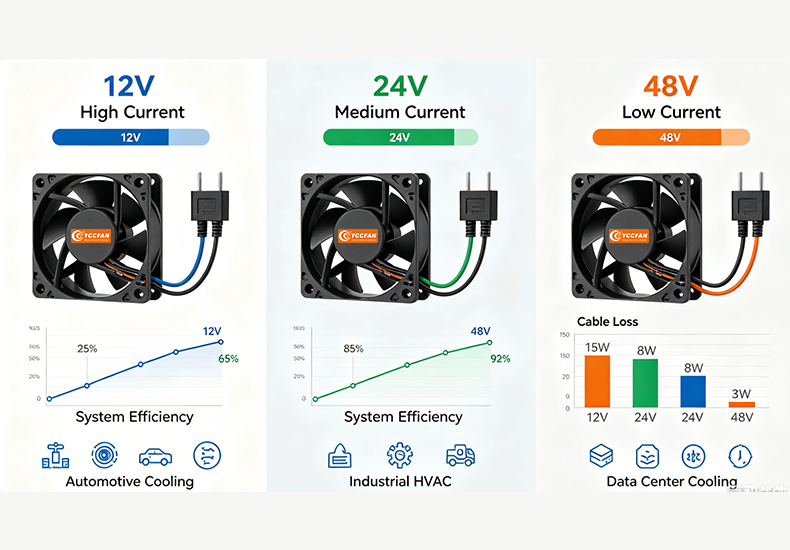
Voltage selection is equally critical at the system level because it impacts cable transmission losses, overall energy efficiency, and long-distance power stability. In multi-fan or cabinet-level cooling systems, different voltage levels also affect operational consistency and control behavior, particularly under continuous load conditions. As a result, voltage becomes a defining parameter that shapes both performance boundaries and long-term reliability of the cooling system.
Why Voltage Choice Is Actually a System Design Decision
In modern electronic cooling systems, DC fans should not be treated as isolated components, but as part of a broader power distribution architecture where voltage selection directly influences how electrical energy is delivered and how current flows across the entire system. This means that voltage is not only related to individual fan operation, but also to overall system design efficiency and power delivery structure.
At the same time, current behavior plays a critical role in system performance, since higher current leads to increased resistive losses in cables, which in turn generates additional heat and reduces energy efficiency. In long-distance or high-load power delivery scenarios, these losses become more significant, affecting both voltage stability and the overall thermal balance of the system, ultimately influencing cooling performance at the system level.
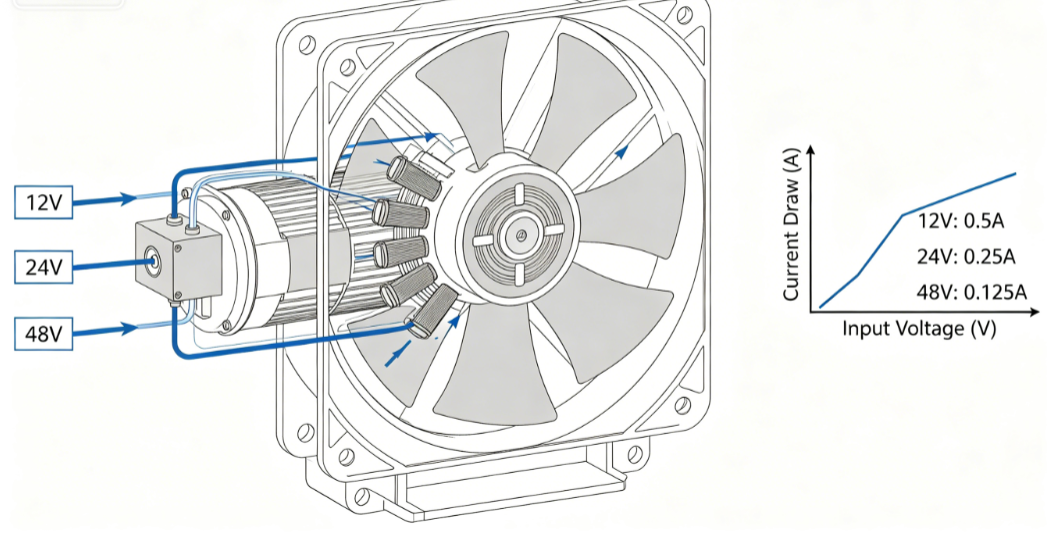
12V vs 24V vs 48V DC Fans Comparison
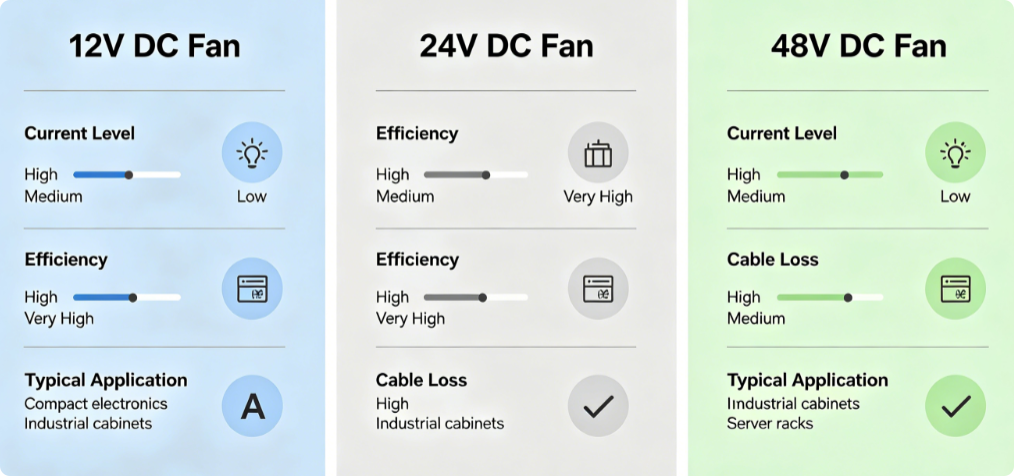
Voltage | Current Level | Efficiency | Cable Loss | Typical Application |
12V | High | Medium | High | Compact electronics, consumer devices |
24V | Medium | High | Medium | Industrial cabinets, telecom systems |
48V | Low | Very High | Low | Server racks, data centers, high-density systems |
System Level Applications Where 12V 24V and 48V DC Cooling Fans Work Best
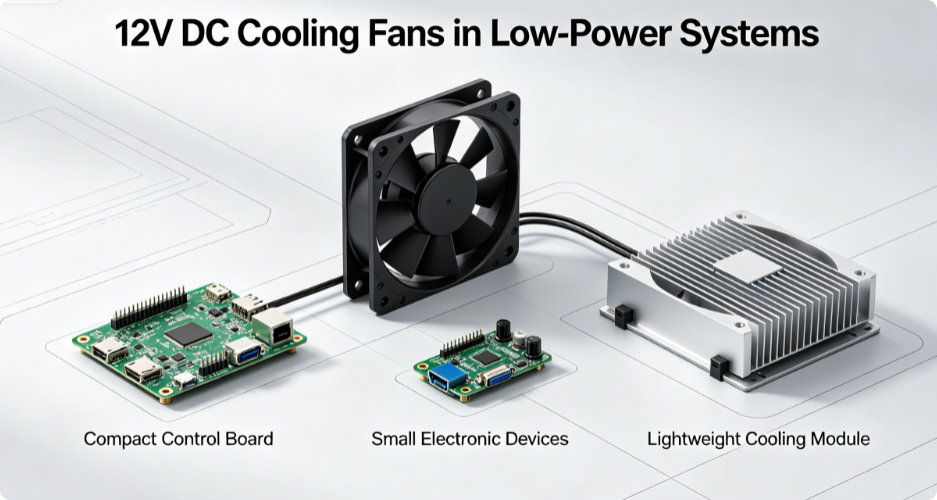
1.Low power systems 12V DC cooling fans
In low power applications such as compact control boards, small electronic devices, and lightweight cooling modules, 12V DC cooling fans are commonly used due to their simple power structure and easy integration. These systems typically operate in short-distance power delivery environments where thermal loads are relatively low and airflow requirements are limited. The focus in these applications is usually on compact design, cost efficiency, and basic thermal management rather than high-density heat dissipation.
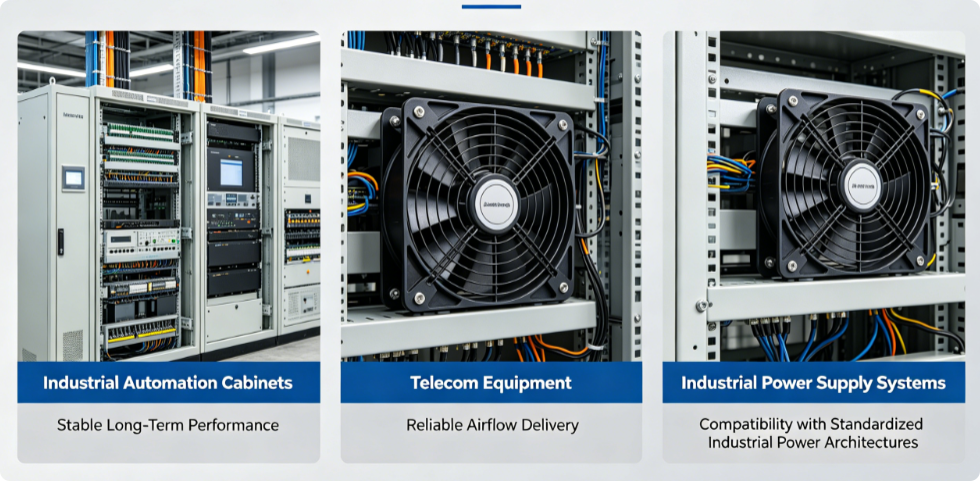
2.Industrial systems 24V DC cooling fans
24V DC cooling fans are widely adopted in industrial automation cabinets, telecom equipment, and industrial power supply systems where operating conditions are more demanding. These environments require stable long-term performance, reliable airflow delivery, and compatibility with standardized industrial power architectures. Compared with 12V systems, 24V solutions provide a better balance between efficiency and stability, making them suitable for continuous operation in structured industrial environments.
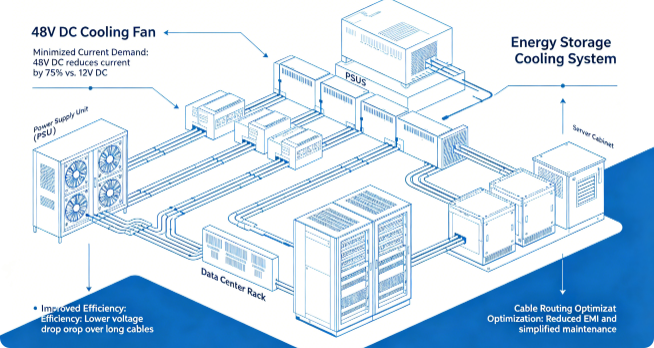
3.High density systems 48V DC cooling fans
48V DC cooling fans are designed for high density and high efficiency applications such as server cabinets, data centers, and energy storage cooling systems. These environments typically involve complex power distribution and long-distance cable routing, where minimizing current becomes critical for improving overall efficiency. The lower current demand of 48V systems helps reduce energy loss, improve transmission stability, and support more advanced high density thermal management architectures.
Key Engineering Factors in DC Cooling Fan Voltage Selection
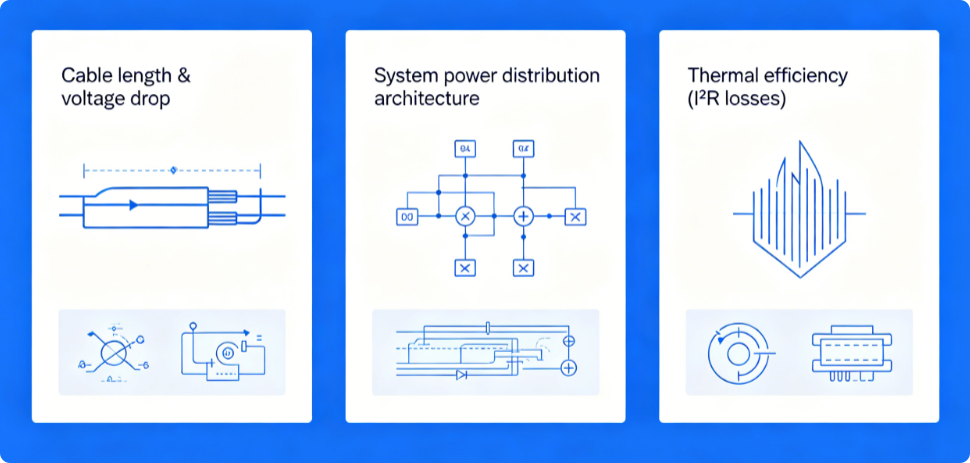
1.Cable length and voltage drop in DC fan systems
In DC cooling fan systems, cable length plays a direct role in determining voltage drop and overall power efficiency. As wiring distance increases, resistive losses become more significant, leading to reduced system efficiency. Higher voltage levels help mitigate this issue by lowering current demand, which reduces transmission loss and improves stability in distributed cooling configurations.
2.System power distribution architecture for DC cooling fans
Voltage selection is closely tied to the overall power distribution architecture of the system. Centralized and distributed power designs may require different voltage strategies to ensure stable operation across multiple cooling units. In cabinet level DC bus systems, voltage choice directly influences how power is delivered to multiple fans and affects system scalability, flexibility, and maintenance efficiency.
3.Thermal efficiency considerations in cooling systems
Electrical losses generated by current flow, such as I²R losses, contribute additional heat within the system. Higher current configurations generate more resistive heating, which increases the overall thermal load that must be managed by the cooling system. By optimizing voltage selection, system designers can reduce unnecessary energy loss, improve efficiency, and achieve more stable thermal performance in continuous operation environments.
How to Choose the Right Voltage Step by Step DC Cooling Fan Selection Guide
Selecting the correct voltage for DC cooling fans requires a structured approach that considers system requirements rather than relying on fixed assumptions. A step by step method helps ensure the voltage level matches real operating conditions, power architecture, and thermal demand.
Step 1 Identify system scale
The first step is to understand the overall size and complexity of the application, since this directly affects power demand and cooling requirements. Smaller electronic devices usually operate with limited thermal load and simpler power structures, making 12V DC cooling fans a common choice. Mid sized industrial cabinet systems require more stable and continuous cooling performance, which is often supported by 24V configurations. Larger systems such as server infrastructure demand higher efficiency and more stable power delivery over longer distances, which typically aligns with 48V DC cooling fan solutions.
Step 2 Check power distance
The next step is to evaluate how far power must travel within the system. In compact layouts with short wiring paths, voltage drop is less significant, so lower voltage options like 12V or 24V can perform effectively. In distributed systems or larger cabinet structures where power needs to travel longer distances, higher voltage options such as 24V or 48V are more suitable because they reduce current demand and help improve transmission efficiency while minimizing energy loss.
Step 3 Evaluate thermal load density
Thermal characteristics also play an important role in voltage selection. Systems with low heat generation can operate efficiently with lower voltage cooling solutions. As thermal density increases, the need for more stable and efficient cooling performance becomes more important, making 24V systems a balanced option. In high density environments such as server racks or energy storage systems, higher voltage configurations like 48V are better suited to support continuous and demanding cooling requirements.
Final decision logic
After evaluating system scale, power distance, and thermal load, the final selection can be simplified into a clear matching logic. Low power and compact systems generally align with 12V DC cooling fans. Balanced industrial applications are typically suited to 24V systems. High density, high efficiency, and long distance power environments are better matched with 48V DC cooling fans. This structured approach helps ensure voltage selection is driven by system conditions rather than isolated product specifications.
Conclusion
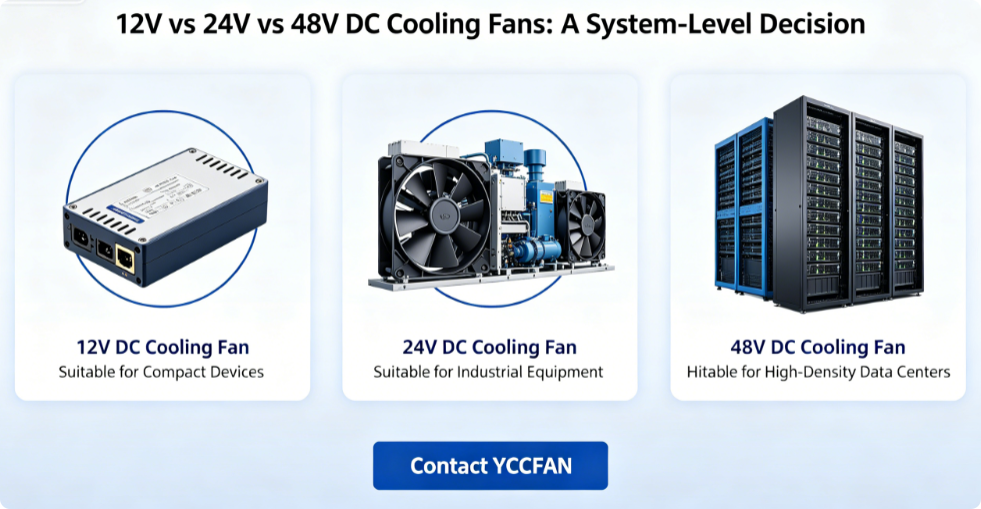
Choosing between 12V, 24V, and 48V DC cooling fans is ultimately a system-level decision rather than a simple product selection. Each voltage level corresponds to different requirements in power delivery, thermal load, and system architecture, from compact devices to industrial equipment and high-density data center applications. By evaluating system scale, power distance, and thermal demand together, engineers can achieve a more efficient and stable cooling design that improves both performance and energy utilization in real-world conditions.
For optimized DC cooling solutions, contact YCCFAN to get professional support in selecting the right 12V, 24V, or 48V cooling fan for your application.
Read more:
Compare 12V, 24V and 48V DC cooling fans to match your system’s power architecture and current budget.