



Axial Fan vs Blower Fan for Server Cabinet Cooling
Server cabinet cooling systems operate in constrained environments where airflow must overcome multiple layers of resistance before reaching heat-generating components. In such conditions, selecting the right fan type is not a matter of preference, but a decision based on how airflow behaves under real system pressure and structural limitations. Understanding the difference between axial and blower fans provides the foundation for building more stable and efficient thermal designs.
Axial Fan vs Blower Fan: Basic Definitions
Understanding the difference between axial fans and blower fans is the foundation for selecting the right cooling solution in server cabinet environments. Although both are used for electronics thermal management, they operate with distinctly different airflow principles and performance behaviors.
Axial Fan Basics
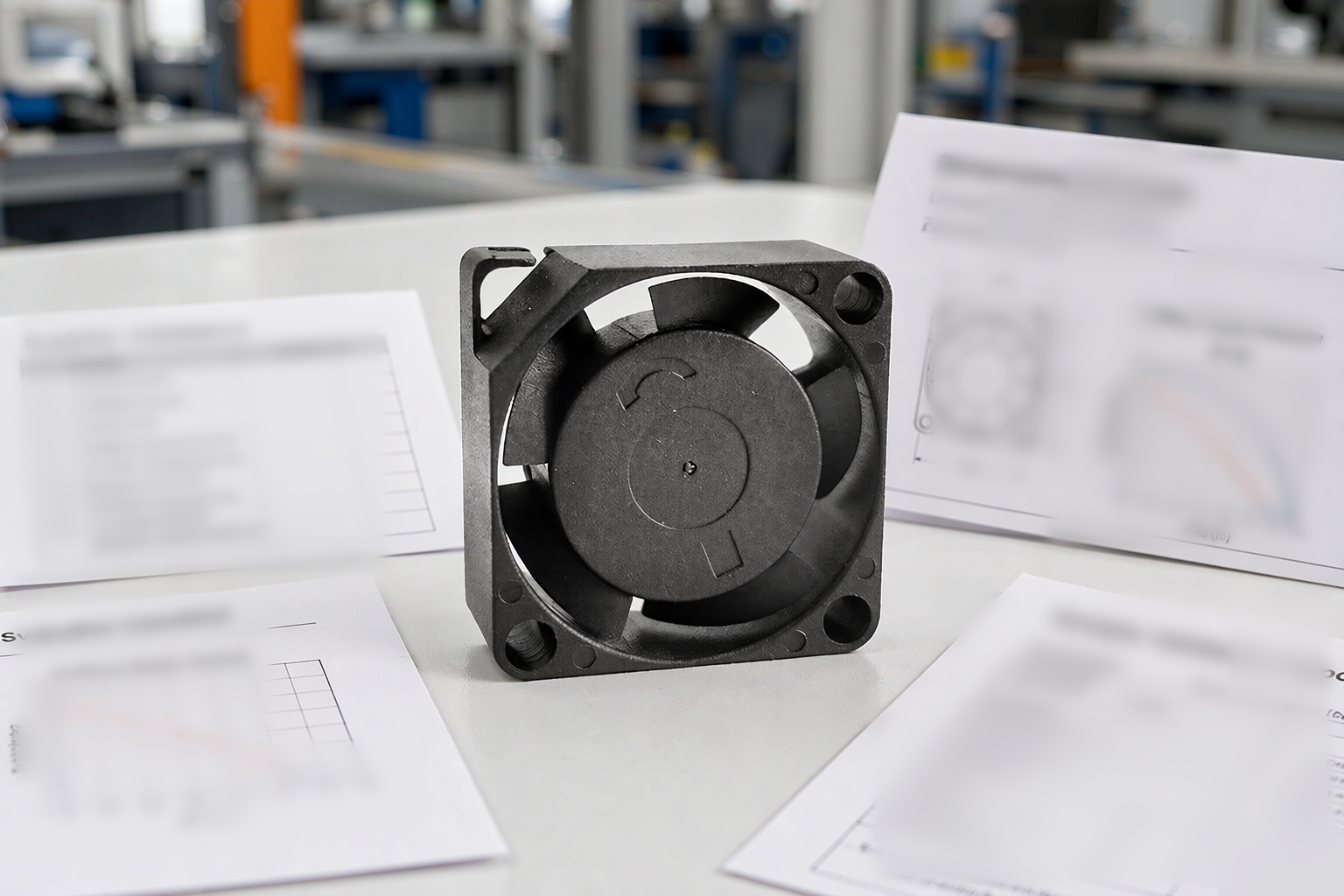
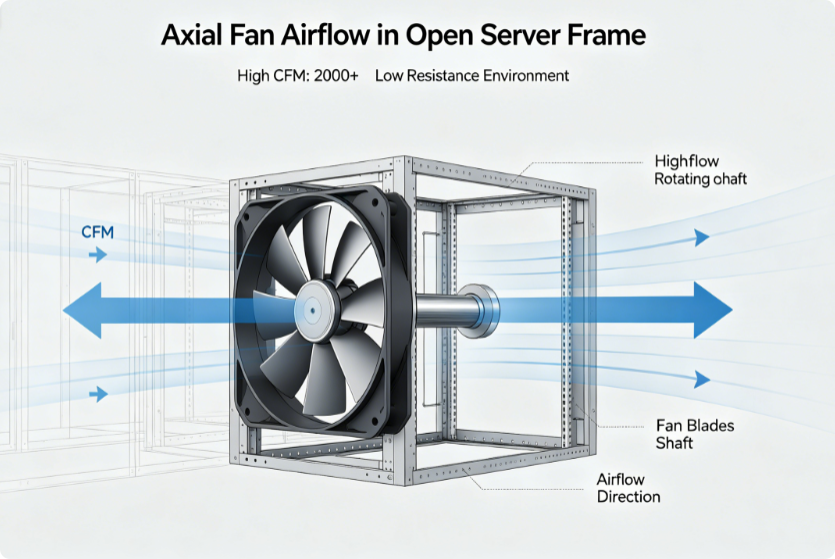
An axial fan is designed to move air along the same direction as the rotating shaft. This creates a straight airflow path that is efficient in low-resistance environments.
In practical use, axial fans are characterized by high airflow volume (CFM), meaning they can move large amounts of air quickly. However, their ability to maintain performance drops when airflow resistance increases.
Because of this, axial fans are typically used in open or lightly obstructed spaces such as open server frames, ventilation panels, or systems with minimal internal blockage where air can circulate freely.
Blower Fan (Centrifugal Fan) Basics
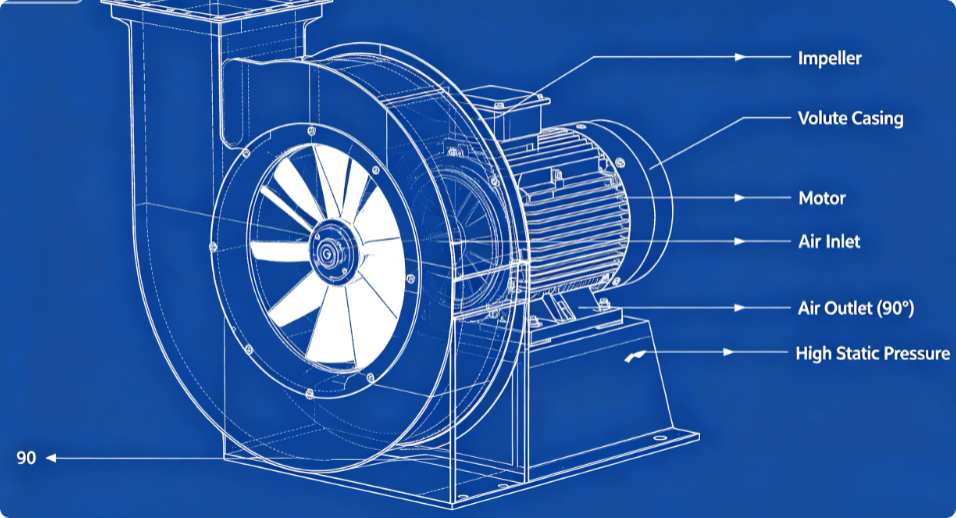
A blower fan operates by drawing air into the impeller and redirecting it at a 90-degree angle before discharge. This structural difference allows it to build and maintain higher static pressure compared to axial designs.
In real applications, blower fans are more effective in environments where airflow faces resistance. They are commonly used in systems with ducts, air filters, or compact enclosures where air must be forced through restricted pathways.
Unlike axial fans, blower fans are optimized for maintaining stable airflow even when internal system resistance is high, ensuring consistent cooling performance in confined or high-density configurations.
Why Server Cabinet Cooling Is a High-Resistance System
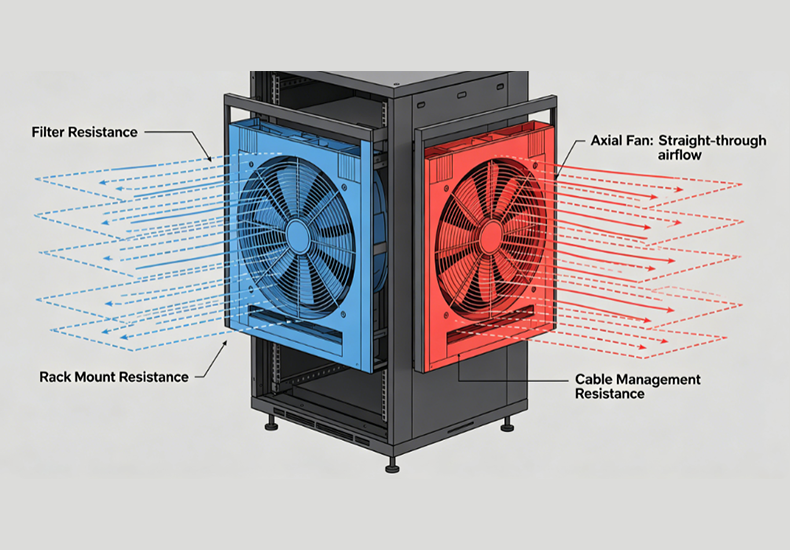
Server cabinets operate in a constrained airflow environment rather than an open space, meaning air must travel through multiple internal obstacles before reaching critical heat-generating components. This includes filters, dense electronic assemblies, cable routing, and long airflow paths inside rack structures, all of which continuously reduce airflow efficiency as air moves through the system.
Because of these resistance factors, airflow behavior inside a cabinet is dominated by pressure loss rather than volume alone. Static pressure becomes the key parameter that determines whether air can effectively penetrate deep into the system and maintain stable cooling performance, especially under high-density or 24/7 operating conditions.
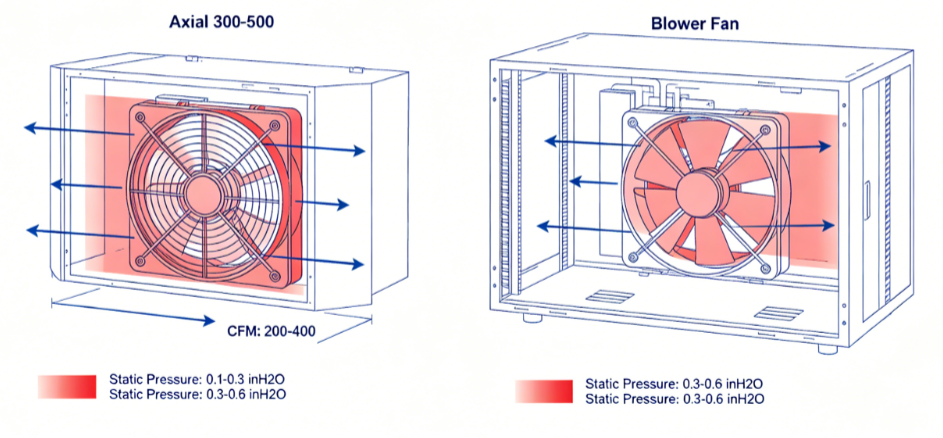
Axial Fan vs Blower Fan in Server Cabinets
A direct comparison helps clarify how each fan type behaves under different cooling conditions inside server cabinet environments.
Performance Comparison
Parameter | Axial Fan | Blower Fan |
Airflow (CFM) | High | Medium |
Static Pressure | Low | High |
Noise Level | Lower in open airflow | Higher but stable under load |
Efficiency under restriction | Drops significantly | Remains stable |
Behavior in Real Cabinet Conditions
Axial and blower fans perform differently depending on how restrictive the cabinet airflow path is, and this directly impacts cooling stability.
Axial fans are generally more effective in open chassis environments where air can move without significant obstruction. In these conditions, their high airflow output allows efficient heat removal with minimal resistance.
Blower fans become more effective when airflow is restricted by filters, dense component layouts, or enclosed cabinet structures. Their ability to maintain pressure ensures consistent cooling even when airflow paths are narrow or obstructed.
In high-density server racks, blower fans provide more stable thermal performance because they can overcome internal resistance and maintain airflow delivery to deeper heat sources.
Axial Fan vs Blower Fan for Server Cabinet Cooling Common Misconceptions
Many cooling inefficiencies in server cabinets are caused not by incorrect hardware selection, but by misunderstandings about how axial and blower fans actually behave under real operating resistance.
1.Higher airflow means better cooling
This is not always true in restricted server cabinet environments. When airflow passes through filters, dense electronic layouts, or long airflow paths, system resistance reduces the effectiveness of airflow volume alone. Without sufficient static pressure, air cannot penetrate deeper heat zones, which leads to uneven cooling performance.
2.Axial fans are always quieter in server cabinet cooling
Noise performance depends on operating conditions rather than fan type alone. Axial fans may perform quietly in open airflow systems, but when resistance increases, they often operate at higher load levels to compensate, which can increase overall noise output in real applications.
3.Blower fans are always louder than axial fans
Blower fans are often assumed to be noisier due to their structure, but in practical server cabinet conditions they can operate at more stable speeds when dealing with high resistance. This stability can result in more controlled acoustic behavior compared to overloaded axial fans.
4.Fan size alone determines cooling performance
Fan diameter does not define real cooling capability in server cabinets. System performance is influenced more by airflow path design and system impedance. A larger fan will not necessarily perform better if it cannot overcome the resistance created by the cabinet structure and internal components.
Hybrid Cooling Strategy for Server Cabinets
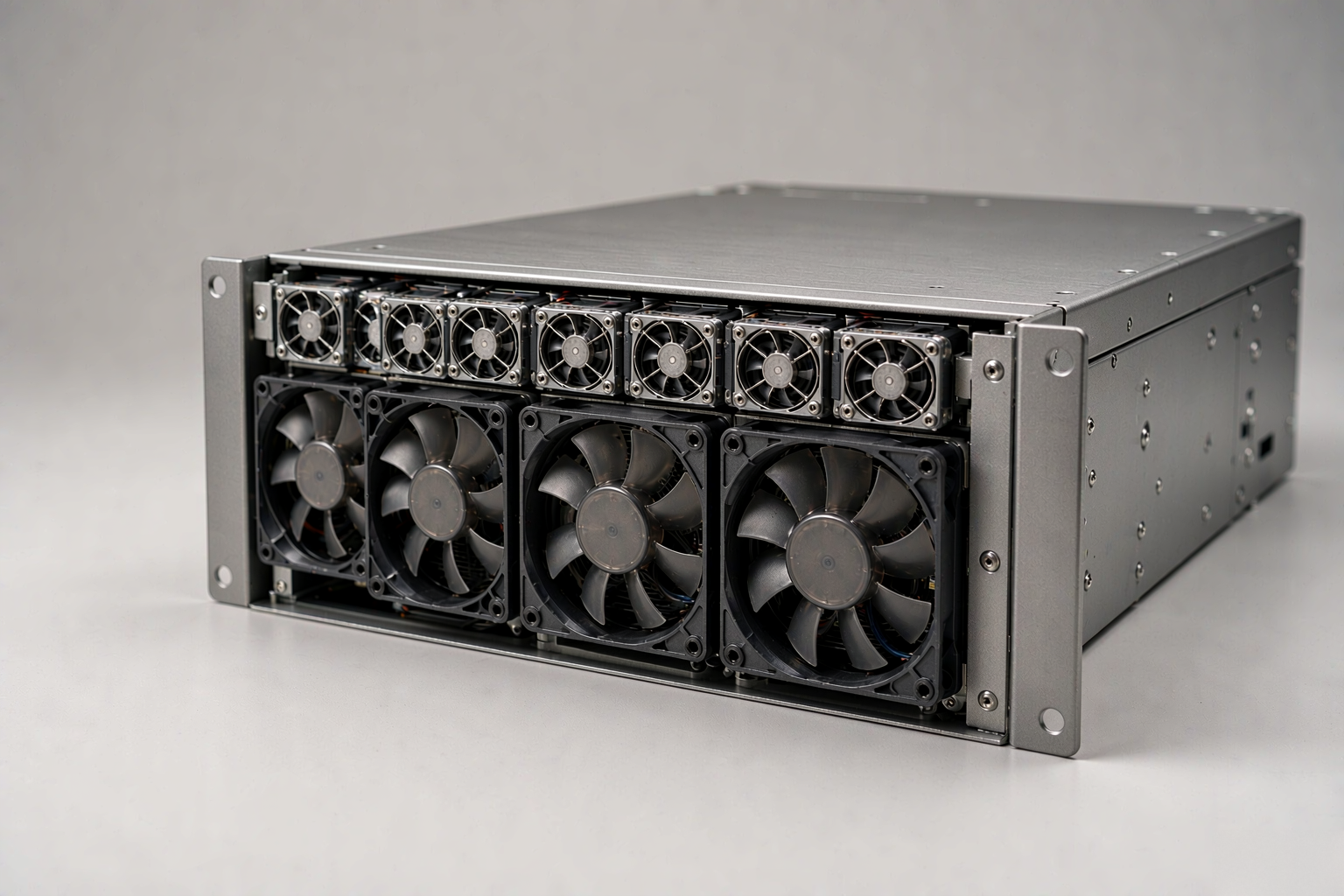
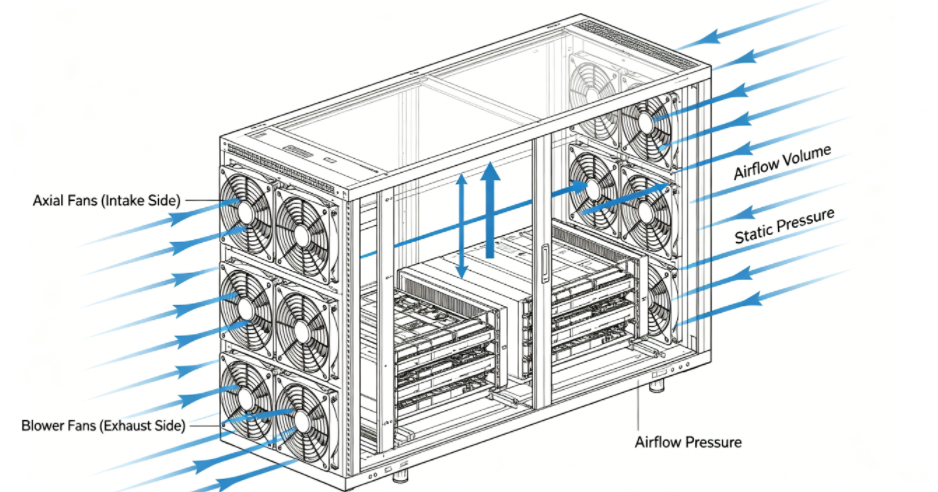
Modern server cabinet cooling design increasingly moves beyond single fan selection. In many real-world applications, axial and blower fans are used together to balance airflow volume and static pressure requirements within the same system.
1.Mixed Airflow Design
A hybrid airflow approach uses different fan types for different functional roles within the cabinet.
Axial fans are typically used on the intake side to move larger volumes of air into the system efficiently, especially where resistance is relatively low at the entry point. This helps establish a stable baseline airflow across the cabinet.
Blower fans are often applied on the exhaust or high-resistance sections, where air must pass through filters, dense components, or constrained exit paths. Their higher static pressure capability ensures that airflow remains stable even when system resistance increases.
Together, this combination helps maintain a more balanced airflow profile, improving both intake efficiency and exhaust stability under varying load conditions.
2.Multi-Zone Cooling Strategy
Server cabinets rarely generate uniform heat distribution. Instead, thermal loads are concentrated in specific functional zones, each requiring different airflow characteristics.
Power supply zones typically require consistent and steady airflow to maintain stable long-term operation. These areas benefit from controlled air distribution rather than high-pressure forcing.
CPU and GPU areas generate higher thermal density and require more aggressive localized cooling, where airflow must penetrate closely packed components and heat sinks.
Rear exhaust zones are often influenced by accumulated system pressure and airflow resistance, making them more suitable for blower-assisted extraction to maintain stable airflow discharge.
By aligning fan type selection with thermal zone characteristics, the overall cooling system achieves more consistent temperature control and improved efficiency across the entire cabinet.
How to Choose Between Axial and Blower Fans
Selecting between axial and blower fans should be based on system airflow resistance and enclosure design rather than individual fan specifications. In server cabinet cooling, performance depends on how effectively the fan matches real airflow constraints inside the system.
1.System Based Selection Logic
Fan selection should follow the level of airflow restriction within the cabinet environment, since airflow behavior changes significantly under different resistance conditions.
Low resistance systems
In open or lightly structured enclosures where airflow paths remain clear, cooling performance is mainly determined by airflow volume delivery. Axial fans are generally suitable here because air can circulate without significant pressure loss, allowing their airflow advantage to be fully utilized.
Medium resistance systems
When airflow encounters partial restrictions such as filters, denser electronic assemblies, or semi-enclosed cabinet structures, the system begins to require a balance between airflow volume and pressure support. In these conditions, higher performance axial fans or hybrid airflow approaches are often used to maintain more stable cooling behavior.
High resistance systems
In compact cabinets or densely packed server environments where airflow is continuously constrained, pressure capability becomes the dominant factor. Blower fans are better suited in these cases because they can maintain airflow delivery even when resistance increases significantly along the airflow path.

2.Key Evaluation Factors
Effective fan selection requires understanding the physical conditions that define how air moves through the cabinet rather than focusing only on fan size or rated airflow.
Filtration and airflow restriction level
As filtration becomes more complex or dense, airflow resistance increases sharply. This reduces the effectiveness of volume-based cooling and increases the importance of pressure-driven airflow delivery.
Internal layout complexity
The arrangement of components inside the cabinet directly affects airflow distribution. Tightly packed systems reduce available airflow channels and create uneven cooling zones that require stronger airflow penetration capability.
Thermal concentration and heat distribution
Heat is rarely evenly distributed in server cabinets. High-density components generate localized hotspots that require more directed and stable airflow rather than general circulation.
System stability under continuous load
In long-duration operation scenarios, maintaining consistent thermal conditions becomes more important than achieving short-term airflow peaks. Stable airflow delivery over time is critical for preventing gradual thermal buildup.
Conclusion
In real server cabinet applications, effective cooling is achieved not by selecting a single fan type, but by aligning airflow strategy with system structure, resistance level, and long-term operational stability.
Contact YCCFAN today to get a tailored server cabinet cooling solution and optimize system performance with the right axial or blower fan selection.
Read more:
https://www.yccfan.com/articledetail/12v-24v-and-48v-dc-cooling-fans-how-to-choose.html
Browse DC axial fans for server cabinets to pair high airflow with standard rack mounting dimensions.